
Anatomy of a safe asset: Bund market structure and reform Mark Kerssenfischer, Konrad Lucke, Willy Scherrieble
This paper builds a non-anonymous transaction-level dataset for German Bunds, the euro area's benchmark safe asset, from MiFID I and MiFID II transaction reports since 2008. It shows that a concentrated dealer core intermediates this safe asset through persistent dealer–client relationships. Trading is segmented across investor sectors, with order flow fragmented across bilateral OTC and electronic venues. The same data identify who supplies safe assets in stress, whose flow moves prices, who pays for immediate execution, and how two reforms work.
How the market works
The main fact is hierarchy. A small primary dealer core intermediates most activity and connects a broad client periphery. Clients rarely trade directly with one another. Clients reach that core through narrow, persistent relationships: most bilateral clients use a single dealer, and platforms broaden dealer access without turning Bund trading into an all-to-all market. Retail trading occurs mainly on regulated exchanges.
A handful of bonds account for much of the trading, especially recently issued benchmarks and bonds deliverable into Bund futures. Activity is spread across many venues, so most combinations of bond and venue are inactive on a given day. Investor sectors also reach the market through systematically different protocols: official sector institutions, insurers and pension funds, and investment funds mostly use electronic platforms; banks split between platforms and bilateral trades; households concentrate on retail exchanges and bilateral execution. Hedge funds and official accounts, the most price-relevant sectors, mostly use platforms.
Who trades, who moves prices, and who pays
Quarterly holdings can show who held Bunds at quarter end, but they miss the acute days when prices move. We use identified transaction flows to separate three episodes: the Covid dash for cash, the 2023 flight to quality around Silicon Valley Bank, and the 2025 repricing after news about future German borrowing.
In both the 2020 dash for cash and the 2023 flight to quality, foreign official accounts are the dominant net sellers, while hedge funds buy. Primary dealers absorb material selling in the Covid cash shock, but not in the 2023 safety shock. After the 2025 fiscal supply news, primary dealers are net sellers, distributing Bunds to end investors rather than warehousing the supply shock.
We also rank whose flows are most price relevant. Hedge fund and official sector buying predicts a lasting rise in a bond's price relative to the German yield curve. We read the official sector result as reserve management rather than private information: official accounts buy bonds that cheapened the day before. If trading costs mainly charged for better information, those sectors would pay the highest immediate execution costs. They do not. Retail households pay by far the highest effective half-spreads, and larger trades also pay more. In Bunds, the effective half-spread is an immediacy cost, not simply a charge for adverse selection.
Reform scenarios
We study two reforms that target the dealer core at different stages. Central clearing keeps the observed trades in place and nets each dealer's obligations after execution. Before Covid, it would cut dealers' net settlement obligations by 35%, from 17.2 to 11.1 billion euros per settlement day, less than comparable estimates for U.S. Treasuries and U.K. Gilts. This accounting exercise measures settlement efficiency gains before central counterparty fees, initial margin, liquidity costs, behavioral changes, or euro area implementation constraints.
A clearing house settles each dealer's net separately, so one dealer's net purchase does not cancel another dealer's net sale. Bund dealers net less than Treasury dealers: interdealer trades are about as common in both markets, but in Bunds they net 24% within dealer, against 63% in Treasuries, and a quarter of dealer obligations falls on bonds that a dealer only bought or only sold that day.
Platform centralization works before execution. It changes whom investors can reach, how aggressively dealers compete, and whether bilateral relationship value is lost. In the Bund version of a dealer-investor model, forced platform centralization lowers welfare when relationship value enters surplus and dealers set platform quotes strategically: the matching gains from broader dealer access do not offset the loss of relationship surplus. The sign matches the Canadian estimates the model was built on, and in the benchmark calibration the losses are larger; their size depends on an imported demand elasticity and on the reference dealer, which the Bund data do not pin down. The result becomes positive only when dealers quote competitively or relationship value affects choices but is not counted as a direct benefit.
Implications for policy and research
The broader message is that market structure matters even for a benchmark safe asset. It shapes who absorbs stress flows, whose trading moves prices, who pays for immediate execution, and which reform gains reach the market. Central clearing and platform centralization target different margins, so policy should evaluate them separately. Although MiFIR transaction reports cannot be shared with external researchers, we will maintain the cleaned dataset and its documentation as a reusable resource for authorized research within the Bundesbank.
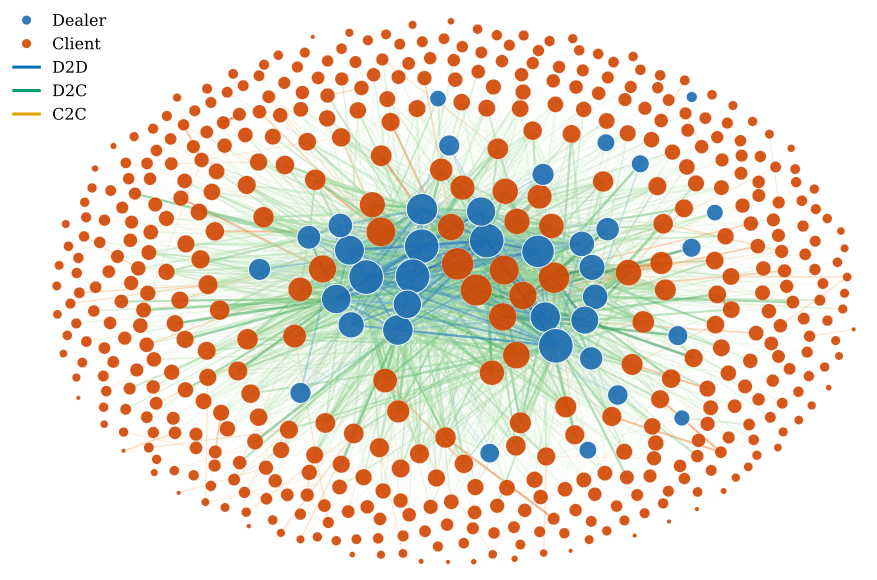
Figure 1. Bund trading network. Nodes are counterparties, with dealers in blue and clients in orange. Edges show dealer-to-dealer, dealer-to-client, and client-to-client trading links.
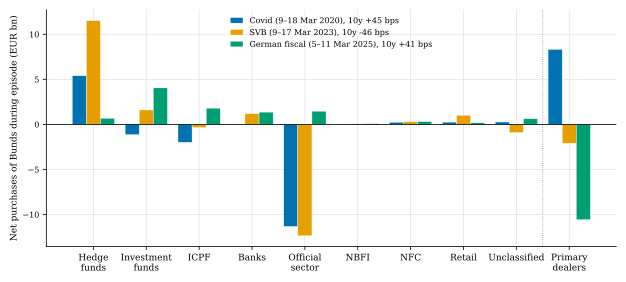
Figure 2. Net Bund purchases by sector and reporting category across three stress episodes. Bars are euro billions over acute event windows; negative values denote net sellers. Retail denotes natural persons; unclassified denotes unmapped legs; primary allocations are excluded. The 2020 window predates the United Kingdom’s departure from the EU reporting perimeter in January 2021, so cross-episode magnitudes are not directly comparable. ICPF = insurers and pension funds; NBFI = non-bank financial intermediaries; NFC = non-financial corporations.
Kerssenfischer, M., K. Lucke, W. Scherrieble (2026), Anatomy of a safe asset: Bund market structure and reform, Bundesbank Discussion Paper, No 36/2026.
1 MB, PDF