
The macroeconomics of stablecoins Boris Hofmann, Matthias Kaldorf, Matthias Rottner
What are the macroeonomic implications of stablecoins? As stablecoin market capitalisation has grown rapidly and is projected to expand further, this question has become increasingly important. We develop a quantitative macroeconomic model with stablecoins and show that they affect the economy through two countervailing channels: a bank lending channel and a fiscal space channel. Calibrated to the U.S., the model predicts a modest decline in long-run output, although the net effect depends on reserve regulation, public debt and foreign demand.
Introduction
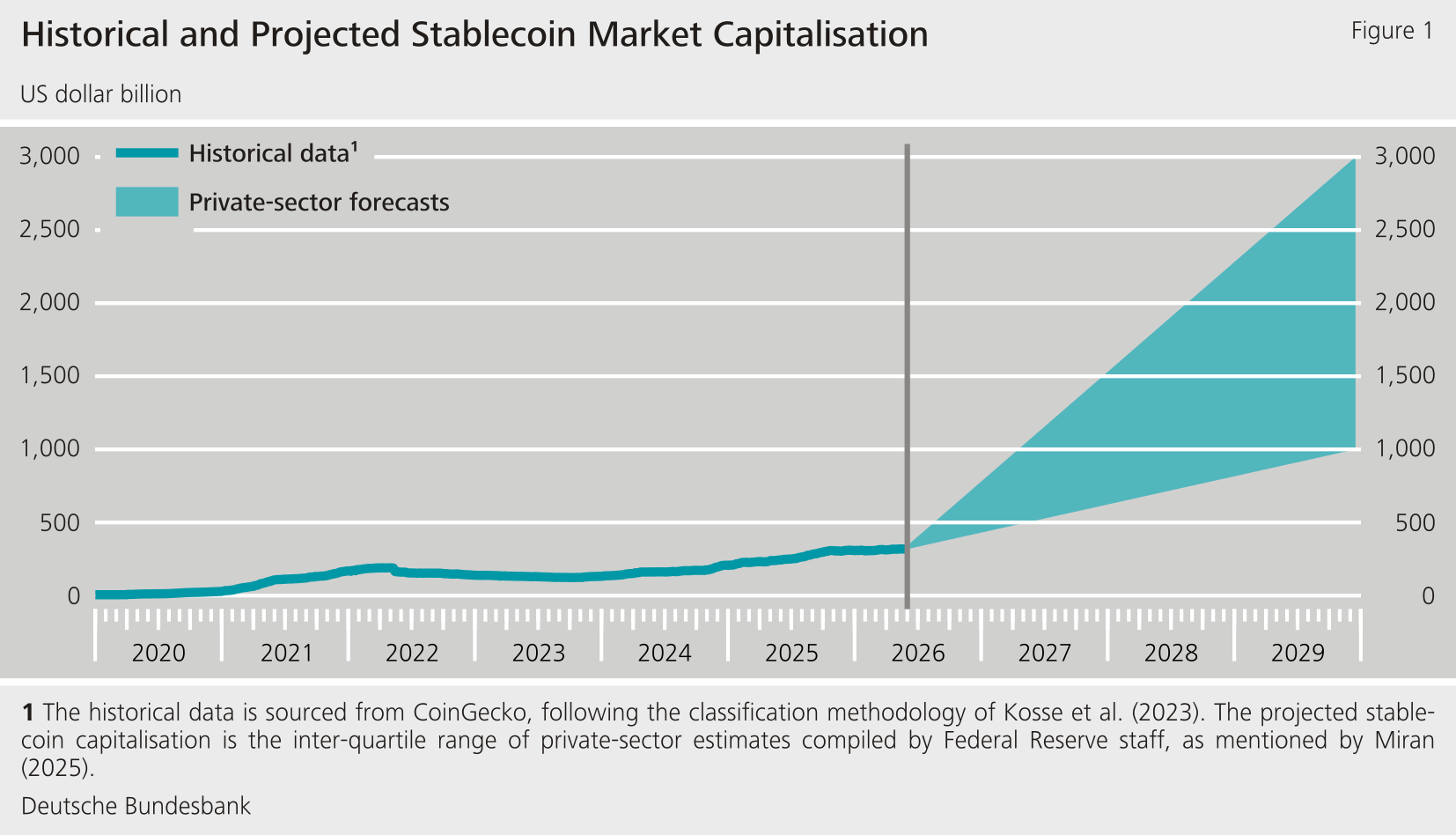
Stablecoins are crypto-asset tokens pegged to a reference asset, most often the U.S. dollar, and have become the dominant medium of exchange in the crypto ecosystem. Their market capitalisation has grown rapidly in recent years and is projected to expand further, although forecasts vary widely (Figure 1). This growth has prompted a growing literature on the implications of stablecoins for payment and financial systems. By contrast, their broader macroeconomic effects remain underexplored.
This paper fills this gap by studying the macroeconomic effects of stablecoin adoption in a quantitative model calibrated to the United States. The model combines elements from the macro-finance and macro-banking literature with distortionary fiscal policy and introduces stablecoins as an alternative liquid asset. This framework allows us to assess how different stablecoin designs and regulatory scenarios affect banks, public finances and aggregate economic activity.
The macroeconomic trade-off of stablecoins
Stablecoins affect the economy through two opposing channels. On the one hand, they compete with bank deposits, making bank funding more expensive and reducing credit supply to firms. This bank lending channel lowers investment and output. On the other hand, stablecoin issuers hold short-term government bonds as reserve assets. Their demand for Treasury bills lowers government financing costs and expands fiscal space, allowing for lower taxes or higher spending. In our baseline calibration, the bank lending channel slightly dominates in the long run, leading to a modest decline in output. However, the fiscal space channel operates more quickly during the transition, and the overall effect depends on stablecoin regulation, foreign demand and fiscal conditions.
Stablecoins may modestly reduce output in the long-run
We calibrate the model to U.S. macro-financial data and consider stablecoin adoption between USD 1 and 3 trillion, in line with recent projections for 2030. In the baseline scenario, stablecoins are held domestically and backed by short-term government bonds. An increase in adoption lowers long-run output modestly, as the contraction in bank credit slightly outweighs the fiscal benefits from lower government borrowing costs. The aggregate effect is small because households partly substitute away from cash rather than deposits, banks adjust their asset holdings, firms rely more on equity financing and the government shifts toward shorter-term debt. This output effect, however, understates the overall welfare implications. Stablecoins also provide liquidity, transaction and safety services to households. Once these benefits are included, stablecoin adoption raises welfare despite the small decline in long-run output. The effects of stablecoin adoption also differ over time. While our analysis mainly focuses on long-run outcomes, the transition can be expansionary. The reason is that the fiscal space channel operates quickly: additional demand for Treasury bills lowers government financing costs and allows for lower distortionary taxes.
Macroeconomic effects depend on the regulatory environment
Stablecoin regulation matters because it shapes both reserve investment and the allocation of profits. We consider two alternatives to Treasury-bill backing: reserves held as bank deposits and reserves held at the central bank. Requiring issuers to hold bank deposits may seem to protect bank funding, but in general equilibrium, households still demand higher deposit rates, while lower Treasury-bill demand weakens the fiscal space channel. This makes the output effect more negative than in the baseline. By contrast, backing stablecoins with unremunerated central bank reserves shifts issuance profits to the public sector, strengthening fiscal space. Foreign demand works similarly by lowering government borrowing costs without further reducing domestic bank deposits. The macroeconomic effects of stablecoins, therefore, depend crucially on reserve regulation, seigniorage allocation and the source of demand.
Stablecoins can amplify monetary policy shocks
Stablecoins also change the transmission of monetary policy. In our model, they amplify the real effects of monetary policy shocks through the bank lending channel. Because households hold a larger stock of liquid assets when stablecoins are available, deposit rates respond more strongly to changes in the policy rate. This makes banks’ funding costs more sensitive to monetary policy. As higher funding costs are passed on to firms, a contractionary policy shock leads to tighter credit conditions and a stronger decline in output.
Conclusion
In this paper, we develop a quantitative macroeconomic model to assess the implications of widespread stablecoin adoption. Stablecoins affect the economy through two opposing channels. On the one hand, they crowd out bank deposits and thereby reduce banks’ credit supply to non-financial firms. On the other hand, stablecoin issuers demand Treasury bills as reserve assets, raising their prices, lowering government interest expenditures and creating fiscal space. Calibrated to the U.S., the model predicts that widespread stablecoin adoption modestly reduces long-run output, as the bank lending channel dominates the fiscal space channel. This long-run effect, however, depends on stablecoin reserve regulation, the level of public debt and the strength of foreign demand. Moreover, the fiscal space channel operates more quickly than the bank lending channel, generating positive short-run output effects during the transition. The model also suggests that stablecoins strengthen monetary policy transmission through the bank lending channel.
Citation
Hofmann, B., M. Kaldorf, M. Rottner (2026), The macroeconomics of stablecoins, Deutsche Bundesbank Discussion Paper, No 31/2026.
2 MB, PDF