When nonbanks dampen and when they amplify: A yield-curve view of the nonbank lending channel
When nonbanks dampen and when they amplify: A yield-curve view of the nonbank lending channel
Peter Bednarek, Francesco Febbraro, Steven Ongena, Natalja von Westernhagen
Existing research shows that nonbanks tend to expand credit when banks contract after monetary tightening, thereby dampening the bank lending channel. But this evidence focuses almost exclusively on surprises affecting short-term rates, even though monetary policy moves rates across the entire yield curve. Does the nonbank dampening effect extend to surprises affecting medium- and long-term rates? We find that nonbanks expand lending relative to banks after short-end surprises but contract after medium- and long-end surprises, with financial service institutions and insurers responding differently through distinct balance-sheet channels. The nonbank lending channel therefore depends both on which segment of the yield curve monetary policy moves and on the composition of the nonbank sector.
The nonbank response reverses along the yield curve
Our empirical analysis uses the Deutsche Bundesbank’s supervisory credit register, covering approximately 15.7 million lender-firm-quarter observations between 2019 and 2023. We combine these data with high-frequency measures of unexpected interest-rate movements around European Central Bank announcements (Altavilla et al. 2019), separated into orthogonal components affecting the short, medium and long ends of the yield curve. To isolate credit supply from firms’ demand for credit, we compare lending by banks and nonbanks to the same firm in the same quarter (Khwaja and Mian 2008).
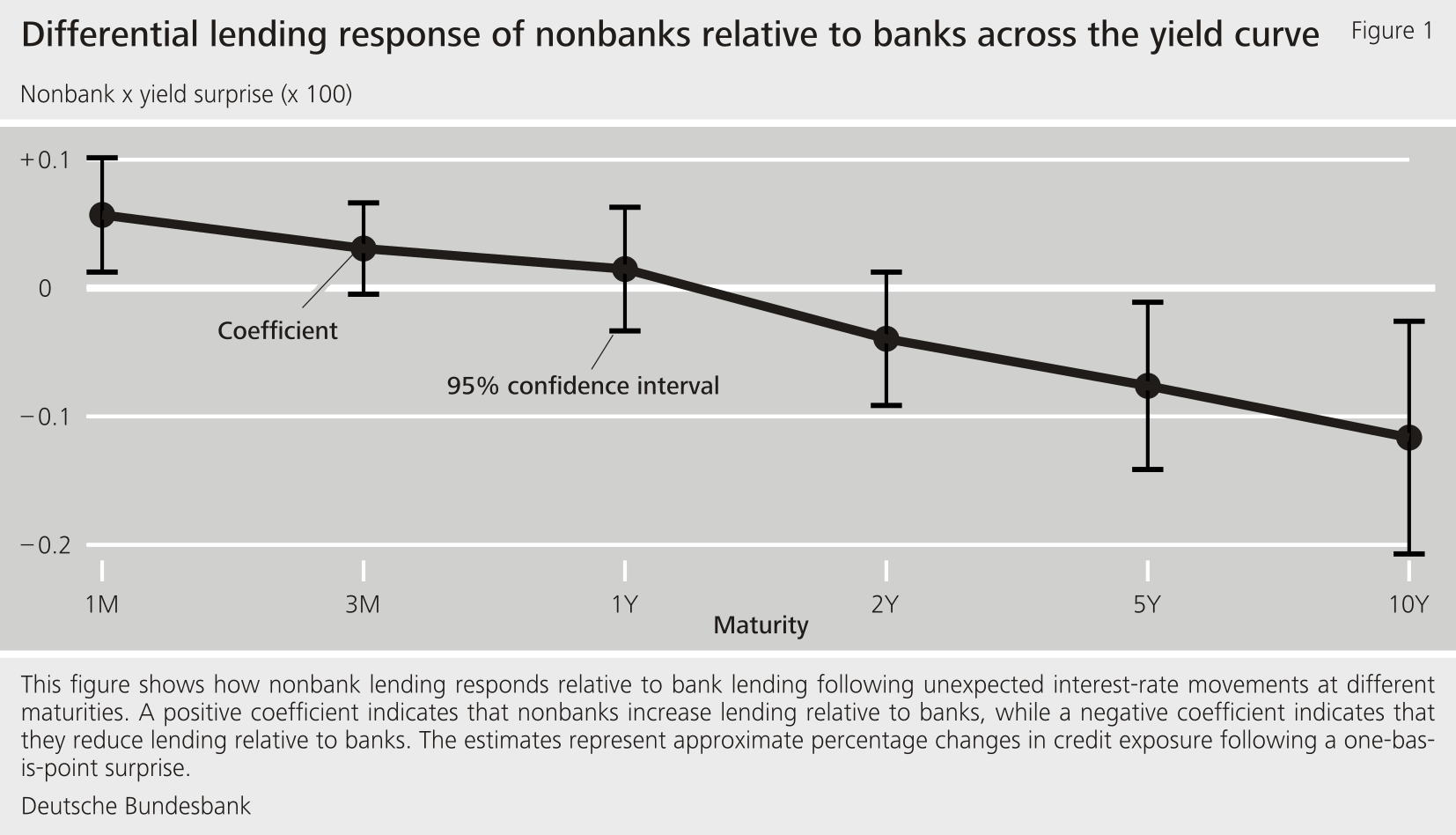
Following a one-standard-deviation short-end surprise, nonbanks increase credit by 0.32 % relative to banks. However, following medium- and long-end surprises, they reduce credit relative to banks by 0.36 % and 0.34 %, respectively. The differential response declines monotonically along the yield curve (Figure 1): positive at short maturities, close to zero around the one-year maturity, and increasingly negative at longer maturities. The dampening effect documented in earlier studies therefore does not extend uniformly beyond the short end.
Different nonbanks respond through distinct balance-sheets channels
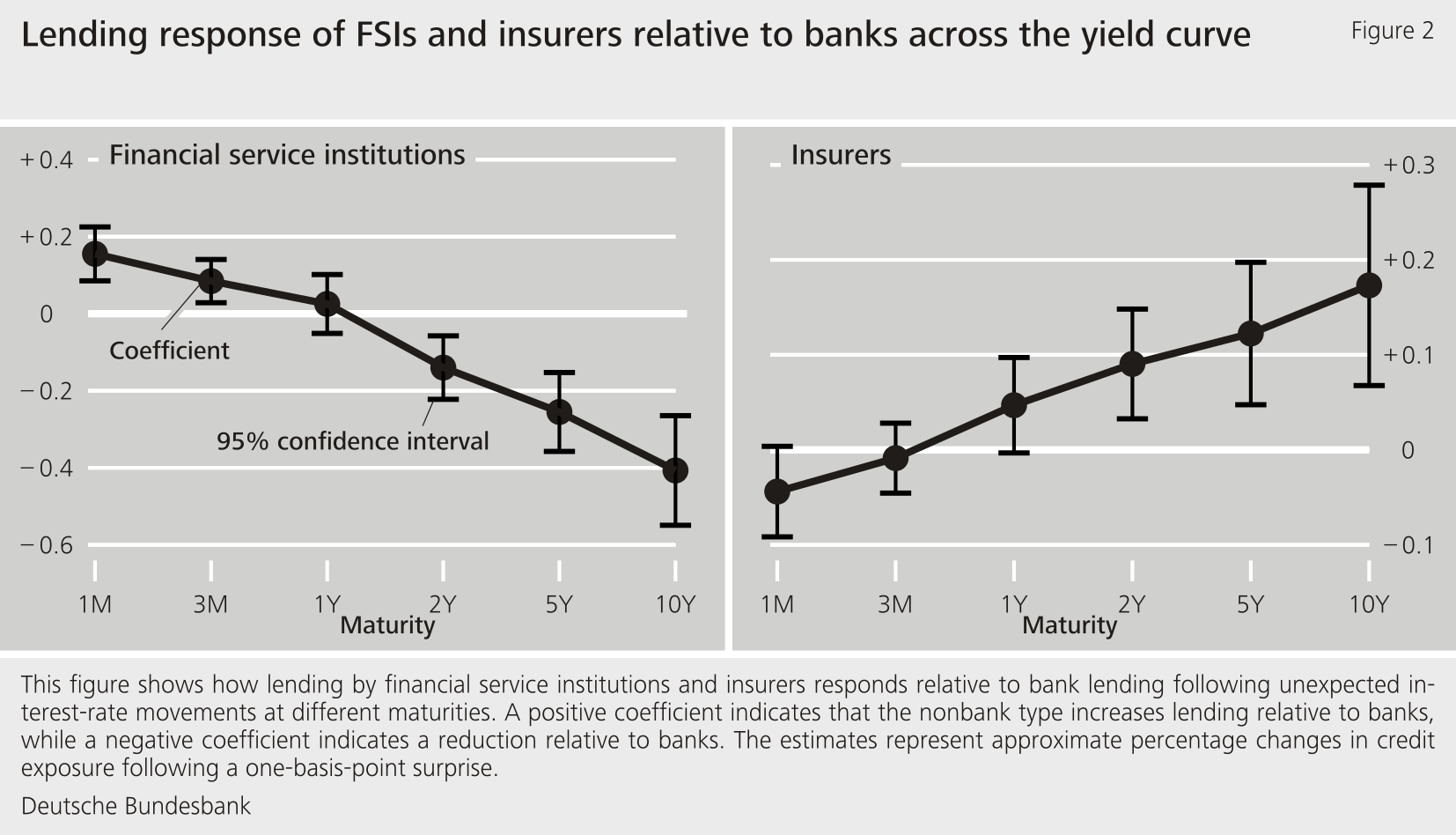
The aggregate pattern is driven primarily by financial service institutions (FSIs), mainly leasing and factoring companies. FSIs expand lending by 0.87 % relative to banks after short-end surprises but contract strongly after medium- and long-end surprises. Insurers partly offset this contraction by expanding lending at longer maturities. We link these contrasting responses to two distinct balance-sheet channels.
For FSIs, the evidence points to a bank-capital reallocation channel. They obtain about 85 % of their funding from banks and thus their lending capacity depends heavily on bank funding. When short-term rates rise unexpectedly, banks’ funding costs adjust faster than income on existing loans, compressing margins and eroding capital buffers (Alessandri and Nelson 2015). Less-capitalised banks respond by shifting lending toward FSIs, which have lower reported default probabilities than non-financial firms and therefore require less regulatory capital. This reallocation disappears at medium and long maturities, when bank exposure to these institutions contracts.
Insurers’ expansion at medium and long maturities is consistent with a duration-driven solvency channel. When such rates rise, the present value of insurers’ liabilities falls. Because the duration of their liabilities typically exceeds that of their assets, the value of liabilities declines more than the value of assets, improving regulatory solvency and potentially relaxing lending constraints. This effect should be stronger for life insurers, whose longer-dated obligations tend to generate a larger negative duration gap than those of non-life insurers. We test this prediction by comparing life and non-life insurers. Consistent with the mechanism, life insurers experience larger solvency improvements and expand lending more strongly than non-life insurers after medium- and long-end surprises.
Nonbank responses reshape credit allocation
Following a short-end surprise, total credit is 0.79 % higher for firms with an existing nonbank relationship relative to firms without one. The corresponding differences are negative after medium- and long-end surprises. Back-of-the-envelope calculations imply approximately €10.7 billion more credit after a short-end surprise, but €18.0 billion and €15.9 billion less after medium- and long-end surprises.
The allocation of credit also varies along the yield curve. Short-end surprises are comparatively favourable to small and medium-sized firms, important clients of FSIs. At longer maturities, insurer expansion is concentrated more strongly among large firms. We find no systematic evidence that nonbanks shift lending toward riskier firms.
Lessons for monetary policy
The nonbank lending channel is not uniform across the yield curve. Surprises to short-term rates can be partly cushioned by nonbank expansion, while surprises affecting medium- and long-term rates are associated with nonbank retrenchment that reinforces the contraction in firm credit.
Because FSIs and insurers respond differently to the same surprises, the composition of the nonbank sector also matters for monetary policy transmission. An economy in which bank-funded FSIs are prominent may respond differently from one in which insurers account for a larger share of nonbank credit. Aggregate monitoring can therefore conceal opposing responses across nonbank intermediaries. Disaggregated monitoring by nonbank type is needed to assess how monetary policy is transmitted through the financial system.
References
Alessandri, P and B D Nelson (2015), “Simple Banking: Profitability and the Yield Curve”, Journal of Money, Credit and Banking 47(1): 143–175.
Altavilla, C, L Brugnolini, R S Gürkaynak, R Motto, and G Ragusa (2019), “Measuring Euro Area Monetary Policy”, Journal of Monetary Economics 108: 162–179.
Cucic, D and D Gorea (2026), “Nonbank Lending and the Transmission of Monetary Policy”, Review of Financial Studies 39(4): 966–1014.
Elliott, D, R R Meisenzahl, and J-L Peydró (2024), “Nonbank Lenders as Global Shock Absorbers: Evidence from US Monetary Policy Spillovers”, Journal of InternationalEconomics 149, 103908.
Khwaja, A I and A Mian (2008), “Tracing the Impact of Bank Liquidity Shocks: Evidence from an Emerging Market”, 98(4): 1413–1442.
Bednarek, P., F. Febbraro, S. Ongena, N. von Westernhagen (2026), When nonbanks dampen and when they amplify: A yield-curve view of the nonbank lending channel, Bundesbank Discussion Paper, No 35/2026