
Quantum computing: new technology brings new challenges
Quantum computers harness the principles of quantum mechanics to process data. That’s what makes them altogether different from “traditional” computers. They work with what are known as qubits, or quantum bits. Unlike classical (binary) bits, which have a state of either 0 or 1, qubits can also be in a coherent superposition of multiple states simultaneously. Given their particular features, it is expected that, in future, quantum computers will be able to solve certain problems exponentially faster than conventional supercomputers.
Quantum computing ceased to be a purely theoretical consideration long ago. In Germany, the first quantum hardware was built in 2021, with 27 qubits (IBM Q System One). Systems already exist worldwide with more than 100 qubits. Several thousand qubits would be needed to provide usable quantum computing. That’s why extensive research into this technology is still necessary. Many experts are expecting, however, to see quantum computers equipped with more than 1,000 qubits become available by 2030.
Use cases for quantum computing are still being explored. Many actors are looking to identify what particular tasks this technology could be used for and to translate those problems into a language a quantum computer can understand. In the financial sector, quantum computing is thought to offer potential in portfolio optimisation, asset pricing, risk modelling and simulation, in particular. These are areas in which substantial efficiency gains could be leveraged over the long run by quantum computing.
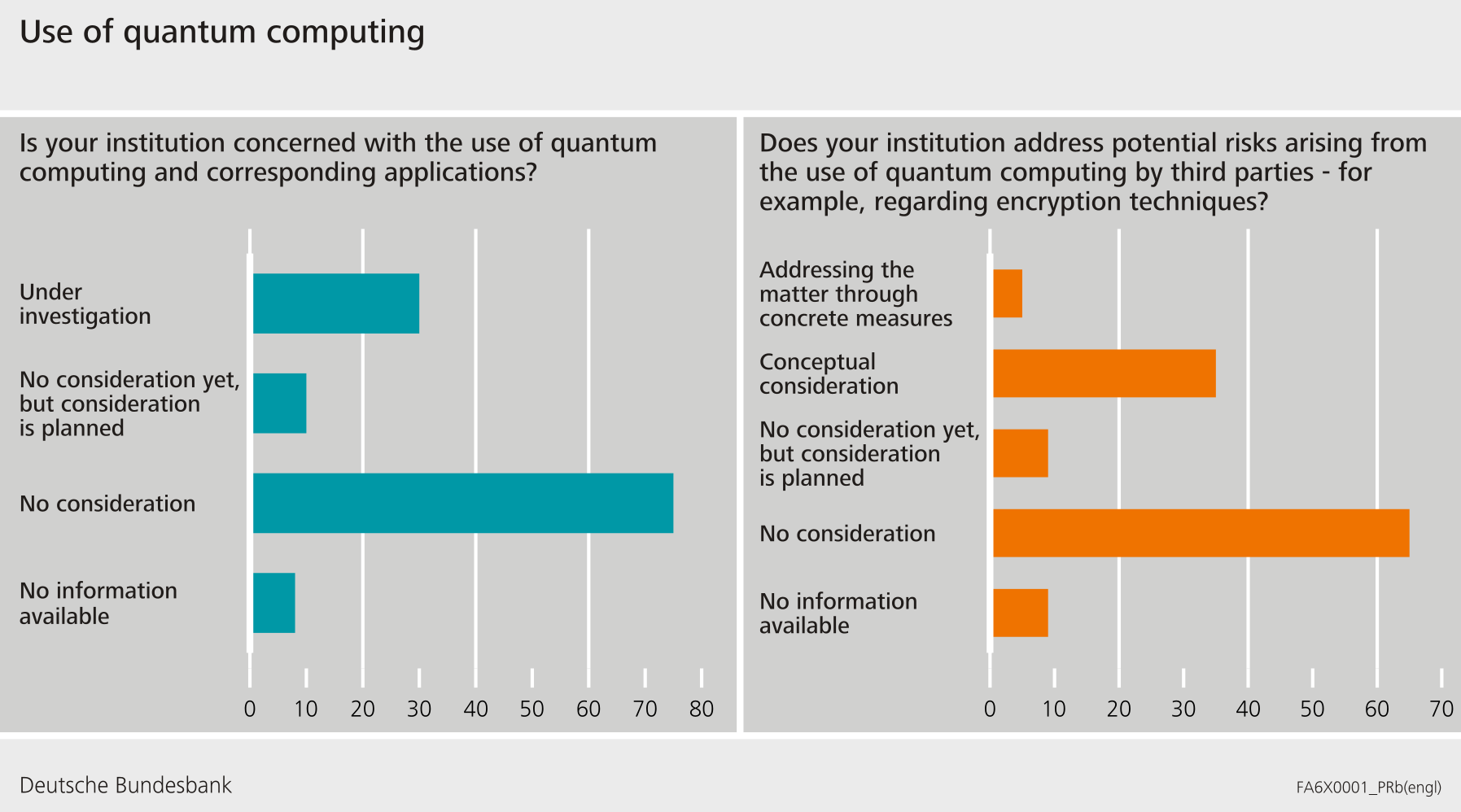
Smaller banks (LSIs) in particular say they’ve devoted hardly any attention to this topic so far, though. A Bundesbank survey on digitalisation in 2025 found that the vast majority of LSIs surveyed had not yet given any thought to using quantum computers or to the risks they present (see Chart 1).
The IT risks surrounding quantum computing are immense. In the foreseeable future, quantum computers will be able to compromise widely used asymmetric encryption systems like RSA and ECC. Today’s secure encryption systems will therefore need to be replaced by quantum-secure alternatives in the future. In technical circles, this switch to post-quantum cryptography is known as PQC migration.
“Harvest now, decrypt later” is a particular danger. In this scenario, attackers intercept and store currently encrypted data with the view that these may one day be decrypted once quantum computing is sufficiently advanced. That risk is particularly relevant for data with long confidentiality lifetimes, such as sensitive financial or health data.
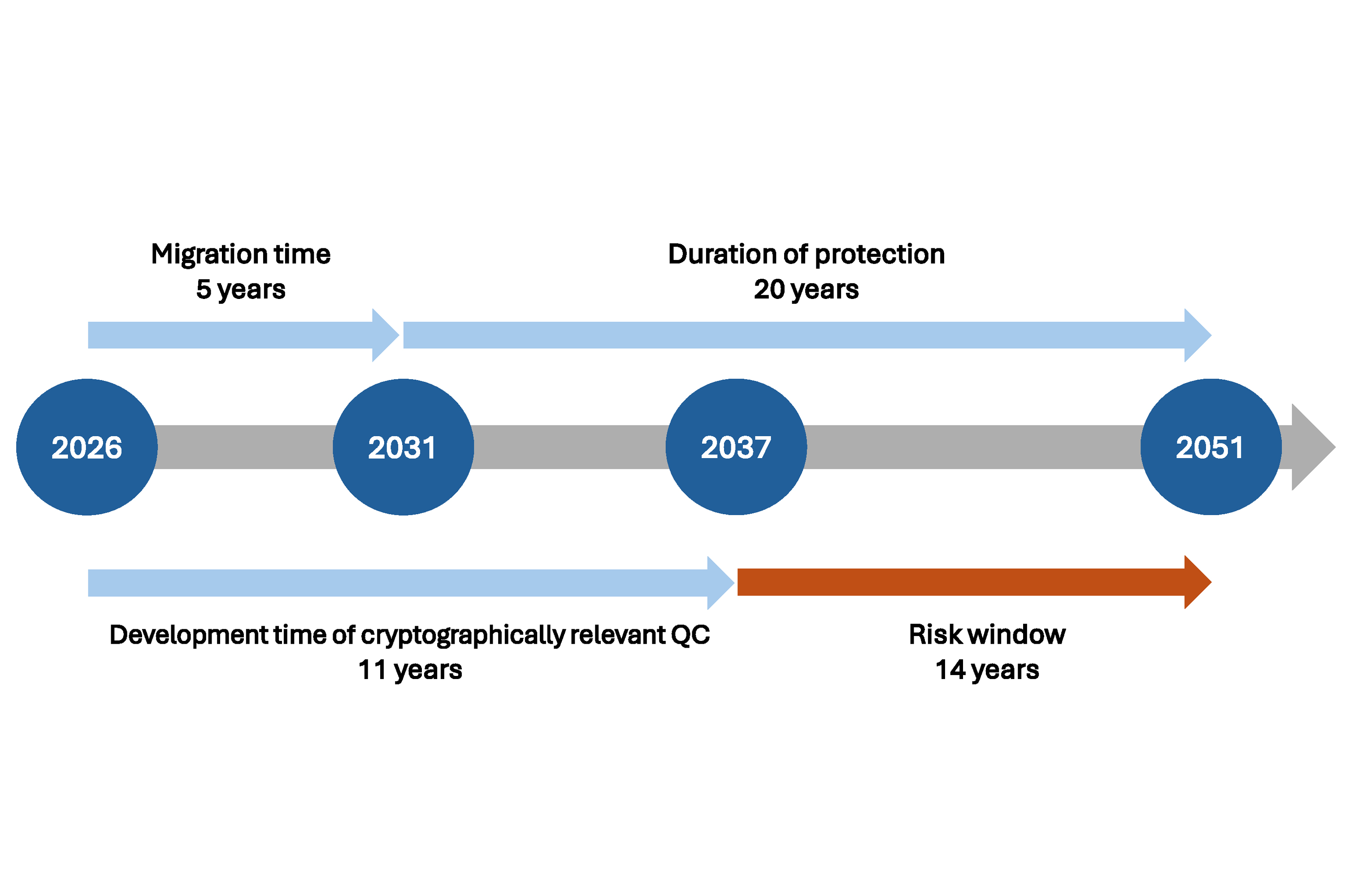
The problem this presents is called Mosca’s theorem (see Chart 2). The following example illustrates this problem. Let us assume a bank uses traditional encryption algorithms to transmit encrypted data that must be kept confidential for 20 years. In this example, PQC migration for that institution takes five years. This means that 2031 would be the last year in which data are encrypted using traditional algorithms, with the intention of keeping those data confidential until 2051. If we now assume that a quantum computer capable of breaking standard cryptographic encryption becomes available in 11 years’ time, any traditionally encrypted data intercepted before 2031 can be decrypted with that quantum computer as of 2037. The resulting theoretical 14-year risk window is a concern for data originating from the period preceding full migration to PQC in 2031 – that is, for data dating from 2017 to 2031. Those data would therefore not be secure.

Cryptocurrency is another area where the risks are considerable. A 2022 study by Deloitte[1] found that roughly 25 % of bitcoins in circulation are insufficiently protected against quantum attacks.
In addition to IT security risks, quantum computers might also influence business models. Financial institutions that adopt this technology early on could gain a significant competitive edge over their peers in certain business areas, such as optimising portfolios, valuing derivatives or detecting fraud.
Widespread migration away from cryptographic systems to PQC is a considerable challenge. Mainly, this is due to the lack of experience with migrations of this kind, the complex dependencies, including the need to synchronise changes to assets, and also the long validity period of certain assets (such as electronic ID cards or payment cards). Full implementation will therefore take several years.
Quantum-resistant encryption systems running on traditional hardware already exist today, as do legal requirements and guidance from IT security authorities on migration. The EU’s Digital Operational Resilience Act (DORA) and Commission Delegated Regulation (EU) 2024/1774, and the recommendations published by the Federal Office for Information Security (BSI), are already calling for security systems to be state-of-the-art and for them to be upgraded as risks evolve. In its January 2026 Technical Guideline on cryptographic mechanisms, the Federal Office for Information Security recommends using classic key agreements only until the end of 2031. For applications with very high protection requirements, the transition to quantum-safe mechanisms should already take place by the end of 2030.
Crypto agility is another topic financial institutions should consider when migrating to quantum-proof encryption. Quantum-resistant alternatives to algorithms that are considered vulnerable have been around for years, but they have been insufficiently researched. Conceivably, then, some of these algorithms will turn out to be still vulnerable. It is therefore crucial to be able to switch quickly and seamlessly between productive cryptographic systems as a way of responding flexibly to new threats. For that reason, the Federal Office for Information Security recommends operating traditional asymmetric cryptographic systems side by side with new quantum-secure algorithms and having a process for quickly deactivating algorithms.
In January 2026, the G7 Cyber Expert Group published a paper recommending six key PQC migration activities as a way of navigating the risks of quantum computing. These activities do not have to be carried out in a particular order and can overlap.
- Awareness and preparation: The first phase is about developing a clear awareness of the risks posed by quantum computing and identifying critical or important functions, relevant data and responsibilities.
- Discovery and inventory: A comprehensive analysis of the existing cryptographic systems is necessary to identify vulnerabilities.
- Risk assessment and planning: Based on the inventory, risks should be assessed and a tailored migration plan drawn up.
- Migration execution: Migration to quantum-resistant encryption systems must be progressively deployed and coordinated.
- Migration testing: The new systems must be fully tested to ensure their security and functionality.
- Validation and monitoring: Post-migration, the systems must be continuously monitored and adapted.
It is important for financial institutions to address this topic promptly as a priority issue. Given the complexity and the long time horizon needed to switch from one cryptographic system to another, it is important to act quickly. Close coordination with service providers, infrastructure providers and other stakeholders, and alignment with the recommendations of the Federal Office for Information Security and international standards are crucial in this regard.
Footnotes: