German general government debt up in 2025 by €144 billion
General government debt in Germany increased by €144 billion in 2025 to €2.84 trillion. Central government debt, including its off-budget entities, grew by €107 billion. State and local governments recorded an increase of €19 billion and €25 billion, respectively. The debt of the social security funds more than doubled from €3 billion to €7 billion. This debt predominantly represents intra-government borrowing from central government and is therefore not counted toward total government debt.
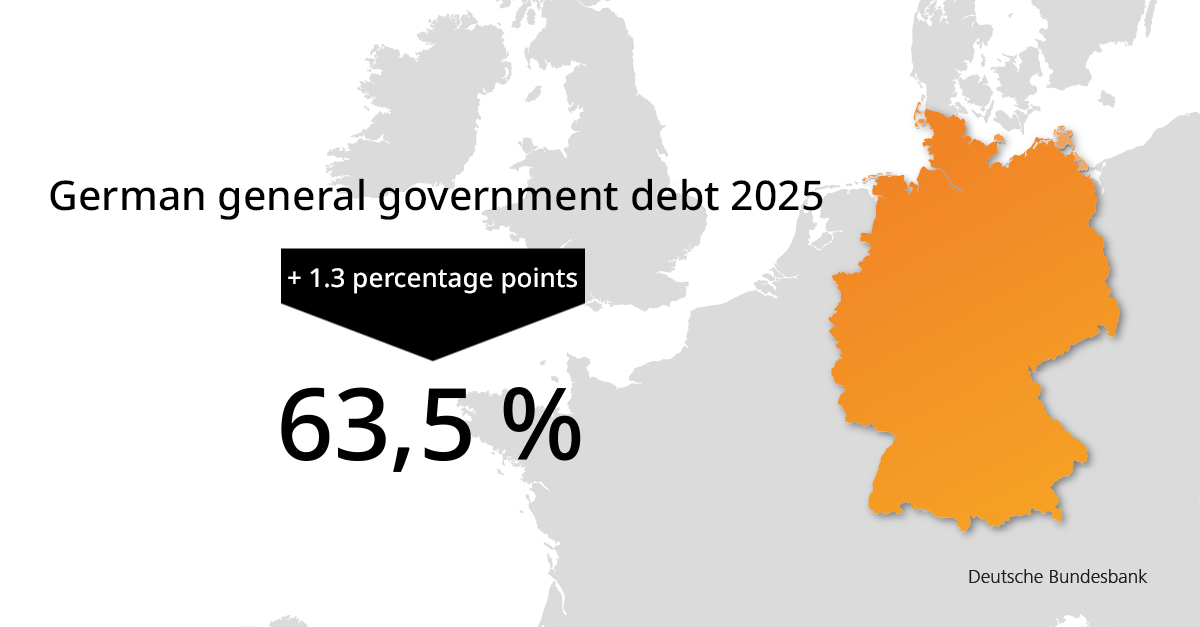
The debt ratio, meaning the ratio of debt to nominal gross domestic product (GDP), rose by 1.3 percentage points to 63.5 %. Taken by itself, the increase in nominal GDP reduced the debt ratio by 2.0 percentage points. Debt growth, on the other hand, increased the debt ratio by 3.3 percentage points in arithmetical terms.
The €144 billion increase in debt was higher than the general government (Maastricht) deficit (€119 billion) published by the Federal Statistical Office. This is mainly due to the fact that part of the debt was used to build up financial assets, and therefore did not count toward the deficit.
Year | Debt level (€ billion) | GDP (%) | Change in debt level (€ billion) |
2025 | 2,838 | 63.5 | 144 |
2024 | 2,694 | 62.2 | 63 |
2023 | 2,631 | 62.3 | 62 |
2022 | 2,569 | 64.4 | 67 |
2021 | 2,502 | 67.9 | 154 |
2020 | 2,348 | 68.0 | 272 |
2019 | 2,076 | 58.7 | − 11 |
In addition to national debt, EU Member States also take on debt collectively at the European level. Ultimately, this joint debt is largely serviced via the EU budget. The Member States’ respective shares in this debt correspond to their financial contribution to the EU budget. Germany’s contribution currently amounts to around one-quarter. The Bundesbank estimates that a share of approximately €118 billion of EU debt, equivalent to 2.6 % of German GDP, is attributable to Germany.
Year | Consolidated debt of EU institutions and bodies (€ billion)* | Germany’s financial contribution (€ billion) | GDP (%) |
2025 | 477 | 118 | 2.6 |
2024 | 284 | 71 | 1.6 |
2023 | 169 | 43 | 1.0 |
2022 | 110 | 28 | 0.7 |
2021 | 58 | 15 | 0.4 |
| * Maastricht debt of EU institutions and bodies less claims of the EU on Member States. It primarily consists of the debt-financed grants to Member States made since 2021 under the Next Generation EU scheme. Source: Eurostat, 2024. The figures for 2024 contain shares estimated by the Bundesbank. | |||
Background: The EU Member States report data on their general government fiscal balance and debt to the European Commission each year at the end of March and end of September in what are known as EDP notifications. The Bundesbank calculates Maastricht debt, the definition of which is harmonised across the European Union. This is largely based on the “debt of the general government budget”, which is calculated using national government finance statistics methodology. The Federal Statistical Office will publish its figures for this on 9 April 2026. In terms of methodology, Maastricht debt has a broader definition so as to make it comparable across Europe. This means that it generally works out significantly higher than the debt level according to national government finance statistics definitions.