
Fewer counterfeits in circulation Loss arising from counterfeiting also decreased
In the first half of 2026 in Germany, the Bundesbank identified approximately 30,000 counterfeit euro banknotes with a total nominal value of €1.75 million in German payments.[1] Compared with the second half of 2025, the number of counterfeits fell by 4.3 % and losses arising from counterfeiting fell by 5.0 %.
Levels of counterfeit money in Germany are low. Statistically speaking, there were seven counterfeit banknotes per 10,000 inhabitants per year,
stated Lutz Lienenkämper, the Bundesbank Executive Board member whose remit includes cash management.
The number of counterfeit €100 banknotes increased, while counterfeits of all other denominations declined. “Recently, there have been more counterfeit €100 banknotes in circulation. Overall, however, the €50 banknote remains in the ignoble first place for counterfeits,
Lienenkämper noted.
The following table shows the distribution of counterfeits across denominations in the first half of 2026 and how it has changed compared with the second half of 2025:
Banknotes | Number | Share (rounded) | Year-on-year change |
€5 | 638 | 2 % | − 10 % |
|---|---|---|---|
€10 | 1,494 | 5 % | − 16 % |
€20 | 7,355 | 25 % | − 13 % |
€50 | 14,222 | 47 % | − 6 % |
€100 | 5,043 | 17 % | + 61 % |
€200 | 850 | 3 % | − 48 % |
€500 | 405 | 1 % | − 21 % |
Total | 30,007 |
|
|
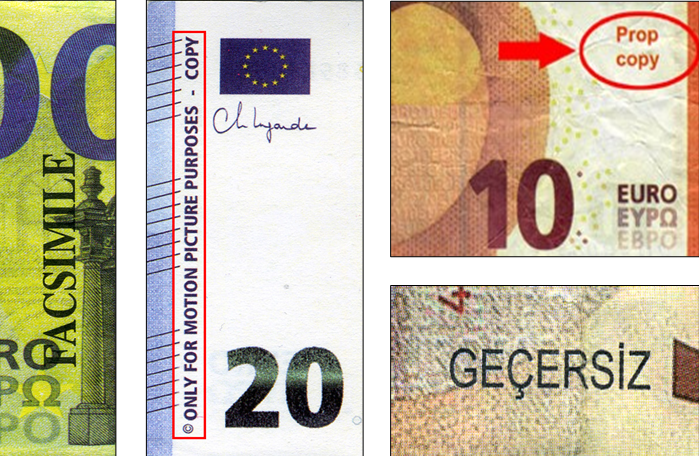
Compared with the second half of 2025, the share of simple counterfeits has risen slightly. In addition to counterfeits with “movie money” or “prop copy” markings, which have often been used in recent years, other versions with lettering such as “facsimile”, “Geçersiz” or similar markings are increasingly being brought into circulation by counterfeiters. These counterfeits are very easy to identify, as they do not imitate any security features and are therefore spotted immediately during inspections.
Selected examples of simple counterfeits:
More counterfeit euro coins in circulation
While some 59,700 counterfeit coins were detected in German payments in the second half of 2025, 64,900 counterfeit coins were detected in the first half of 2026. This represents an increase of 8.6 % compared with the second half of 2025.
In purely mathematical terms, this means that there were roughly 15 counterfeit coins per 10,000 inhabitants in Germany per year.
Counterfeits were identified only in the three highest denominations, and their incidence in the first half of 2026 was as follows:
Coins | Number | Share (rounded) |
50 cent | 171 | 0.3 % |
|---|---|---|
€1 | 5,615 | 8.7 % |
€2 | 59,092 | 91.1 % |
Total | 64,878 |
|
Detecting counterfeits
As counterfeit banknotes are not replaced, euro banknotes should be checked using the “feel, look, tilt” method. It is advisable to compare a suspect banknote with one definitely known to be genuine and to always check more than one security feature.
Most counterfeit banknotes can be easily identified on careful inspection. In particular, things that stand out straight away are often if the paper lacks grip, a watermark or if the emerald number does not change colour.
By contrast, the image on counterfeit euro coins often appears unclear or blurred and the coins are usually strongly magnetic or not magnetic at all, unlike genuine €1 and €2 coins which are only slightly magnetic.
Detailed information on identifying counterfeit banknotes and coins is available on the Bundesbank, ECB and police websites..
Counterfeit prevention
Through its branch network, the Bundesbank provides training courses on counterfeit prevention free of charge to the banking industry, retailers and any other interested parties. In addition, the online training modules listed below (German only) can be accessed via the Bundesbank’s website. Information (in the form of brochures and posters) may also be ordered from the Bundesbank free of charge.