Germany’s international investment position at the end of 2025
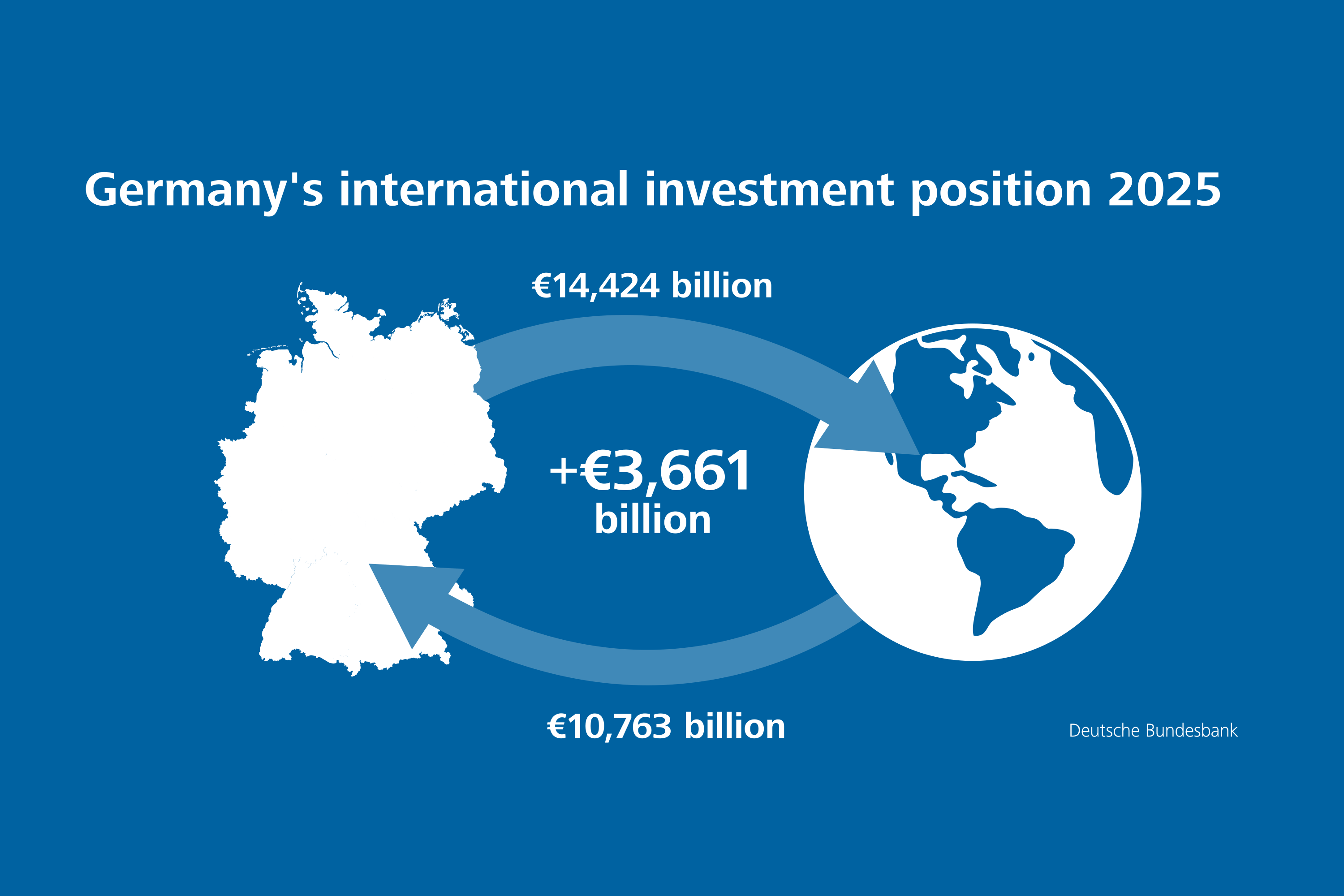
At the end of 2025, Germany’s net external assets totalled €3,661 billion, thus amounting to around 81 % of the country’s nominal gross domestic product (GDP). Overall, both assets and liabilities vis-à-vis non-residents rose further in 2025. Except for financial derivatives and employee stock options, holdings in all sub-accounts went up. Claims and liabilities from cross-border portfolio investment and other investment recorded significant increases. In addition, corporate ties resulting from direct investment by German investors and the Bundesbank’s reserve assets expanded. By contrast, holdings of financial derivatives and employee stock options fell last year. Overall, net capital exports were registered. Viewed in isolation, they increased the net external asset position by €284 billion. However, negative valuation effects and other adjustments limited the increase to €212 billion.
Net external assets up on the year
At the end of 2025, Germany’s net external assets totalled €3,661 billion. This was just over 81 % of Germany’s nominal GDP in 2025, meaning that the ratio remained virtually unchanged on the year. In 2025, the German net external asset position rose by around €212 billion in absolute terms. The cross-border transactions recorded in the financial account resulted in net capital exports of €284 billion last year. They were therefore far higher than Germany’s current account surplus of €200 billion. The difference can be explained by a deficit in the capital account and a positive “errors and omissions” item. Non-transaction-related changes reduced the increase by €72 billion. This was mainly due to high negative exchange rate effects, which significantly exceeded the positive market price effects and the increase caused by other adjustments.[1]
Germany’s claims on non-residents were €605 billion (or 4.4 %) up on the year, reaching €14,424 billion, mainly on account of transactions. Claims rose by €823 billion through transactions. Positive market price effects of €86 billion and other adjustments of €14 billion boosted holdings further. By contrast, viewed in isolation, exchange rate effects reduced the stock value of the assets. The significantly negative exchange rate effect in the reporting year was mainly attributable to losses in the value of the US dollar, the Japanese yen and the pound sterling against the euro. The euro appreciated by around 2.2 % in nominal effective terms[2] over the course of 2025.
The rise in German external liabilities by €394 billion (or 3.8 %) to €10,763 billion was also mainly attributable to transaction-related changes (€540 billion). This contrasted with declines owing to exchange rate effects; however, these were smaller than on the assets side. Negative effects caused by other adjustments and – to a small extent – by market price effects also had a dampening effect.
Further expansion in direct investment
At the end of 2025, German direct investment abroad and foreign direct investment in Germany amounted to €873 billion net. This figure was €26 billion lower than at the end of 2024. Cross-border corporate ties involving German firms expanded. This was true of both German direct investment abroad and foreign direct investment (FDI) in Germany.
German direct investment abroad was up on the year by a total of €63 billion (2.1 %) to €3,073 billion. The contribution made by transactions (€97.5 billion) exceeded the overall increase in direct investment stocks. German investors increased their equity capital in enterprises abroad and, to a much lesser extent, their FDI loans too. The negative valuation effects were driven by the effective appreciation of the euro. The resulting negative exchange rate effects on German FDI stocks outweighed the positive market price effects and other adjustments.
Non-resident enterprises’ direct investment holdings in Germany rose by €89 billion (4.2 %) to €2,200 billion in 2025, mainly driven by transactions. Non-resident investors augmented their equity capital in German enterprises, granting additional intra-group loans to domestic enterprises.
Surplus in portfolio investment smaller than in the previous year
At €999 billion, the portfolio investment balance at the end of 2025 was around €59 billion lower than in the previous year. Increases in securities claims on non-residents outpaced those in German securities holders’ external claims.
At the end of 2025, resident investors held foreign securities totalling €4,946 billion, up by €373 billion (or 8.2 %) on the previous year. Net purchases of foreign securities were one of the reasons behind the increase.[3] Foreign long-term debt securities and fund shares were most in demand. The impact of valuation effects was smaller than that of transactions. Mutual fund shares and shares, in particular, benefited from positive market price effects. By contrast, the relative strength of the euro produced negative exchange rate effects, and other adjustments also had a negative impact on the assets side.
At the end of 2025, non-resident investors held €432 billion (or 12.3 %) more German securities in their portfolios than at the end of 2024, totalling €3,947 billion. Positive market price effects (€289 billion) outweighed securities transactions (€229 billion). Once again, German public bonds were particularly sought-after by foreign portfolio investors. One reason for this was that foreign investors have been increasing their holdings of German government bonds since spring 2023. At that time, the Eurosystem began to scale back its monetary policy asset portfolio. In addition, the Federal Government issued additional debt securities in net terms in 2025 to cover increased financing needs linked to the off-budget special fund for infrastructure and defence adopted in March 2025. Moreover, non-residents acquired German short-term debt securities, while disposing of shares to a lesser extent. The large positive market price effect was broadly attributable to increases in the prices of German shares in foreign portfolios (€263 billion). This is also consistent with the significantly positive development of the German stock index (DAX) in the course of 2025. Exchange rate effects are generally of minor importance for German external liabilities, as these are predominantly denominated in euro. Other adjustments, which, taken in isolation, led to a decline in German external liabilities, had a stronger impact.
Higher positive balance for financial derivatives and employee stock options
At the end of 2025, holdings of financial derivatives and employee stock options registered a positive balance of €72 billion. This was more than in the previous year (€50 billion). Options transactions were the main factor contributing to the rise. The balance of futures trading in gas also made a positive contribution through international hedging, albeit to a lesser extent. After Russia’s attack on Ukraine in February 2022, this balance was very important for a time. It has since declined.
Other investment: Net claims higher
In other investment, Germany’s positive net asset position rose by €156 billion on the year to €1,235 billion at the end of 2025. Other investment comprises loans and trade credits (where these do not constitute direct investment) as well as bank deposits and other capital. In 2025, claims on non-residents arising from other investment rose by €340 billion, or 8.3 %, to €4,426 billion across all sectors. External liabilities rose somewhat less steeply. At the end of 2025, they stood at €3,191 billion, which was €184 billion (or 6.1 %) up on the year.
The net external position of monetary financial institutions (excluding central banks) in the other investment account rose mainly thanks to higher holdings of cash and deposits abroad, primarily vis-à-vis group-affiliated banks.[4] They also granted additional loans to non-residents. By contrast, negative exchange rate effects reduced Germany’s external holdings in these two segments. Non-residents’ deposits increased the liabilities of German monetary financial institutions (excluding the Bundesbank). Overall, the balance of monetary financial institutions (excluding the central bank) in other investment rose by €93 billion in 2025.
The Bundesbank’s net external position in other investment fell marginally by less than €1 billion in 2025. The Bundesbank’s external claims fell by €21 billion due to its lower TARGET balance vis-à-vis the ECB.[5] The Bundesbank’s external liabilities in other investment also fell. Counterparties inside and outside the euro area reduced their deposits with the Bundesbank. This outweighed the higher liabilities arising from euro banknote issuance.
In 2025, other investment by enterprises and households abroad swelled by €69 billion on balance. This was mainly due to transactions that may be linked to activities of financial corporations, for example. General government’s other investment abroad fell by €4 billion.
Further increase in reserve assets
The Bundesbank’s reserve assets amounted to €482 billion at the end of 2025, up by €118 billion on the previous year. Reserve asset holdings rose on the back of positive market price effects in particular (€125 billion), with the rise in the price of gold dominating. Taken in isolation, the appreciation of the euro against the US dollar and other important currencies brought the value of reserve assets down by €8 billion. Transactions boosted Germany’s reserve assets slightly, by €1 billion.
Endnotes
- Non-transaction-related changes include valuation effects as a result of exchange rate or market price movements and other adjustments. Other adjustments include, for instance, write-downs on uncollectable credit claims, changes in sector classifications, changes in the functional category of a financing instrument, as well as statistical discrepancies between the international investment position and the balance of payments due to differing data sources, for example.
- The nominal effective exchange rate comprises the weighted exchange rates of the 18 trading partners most important to the euro area economy (expanded group of countries for which the effective exchange rate (EER) of the EU is calculated).
- For more information on transactions in portfolio investment, see Deutsche Bundesbank, German balance of payments in 2025, Monthly Report, March 2026.
- For more information on transactions in other investment, see Deutsche Bundesbank, German balance of payments in 2025, Monthly Report, March 2026.
- In 2025, TARGET claims on the ECB fell by €23 billion; this decline was less sharp than in 2024 (€47 billion) and 2023 (€175½ billion). Once again, this shows that the winding-down of monetary policy securities portfolios as part of the normalisation of monetary policy has not reduced German TARGET claims since mid-2023 as significantly as they had previously risen when the balance sheet was being built up. One reason for this appears to be a change in investor behaviour in the market for euro-denominated government bonds. For more information, see Deutsche Bundesbank, German balance of payments in 2024, Monthly Report, March 2025.