October results of the Bank Lending Survey (BLS) in Germany Credit standards for loans to enterprises tightened further
The German banks responding to the Bank Lending Survey (BLS) tightened their credit standards for loans to enterprises in the third quarter of 2026. The tightening for loans to enterprises was somewhat weaker than in the previous quarter but slightly stronger than banks had anticipated in the July 2026 survey. Banks cited higher credit risk as the reason for the tightening. By contrast, banks eased their credit standards for loans to households for house purchase. They did not see a need to adjust their credit standards for consumer credit and other lending to households.
The non-performing loans (NPL) ratio and other indicators of credit quality had a tightening impact on banks’ credit standards for loans to enterprises, in particular.
The banks made credit terms and conditions for loans to enterprises and for consumer credit and other lending to households more restrictive on balance. Terms and conditions for loans to households for house purchase remained unchanged, on the whole.
Demand for loans fell in all loan categories in the third quarter of 2026.
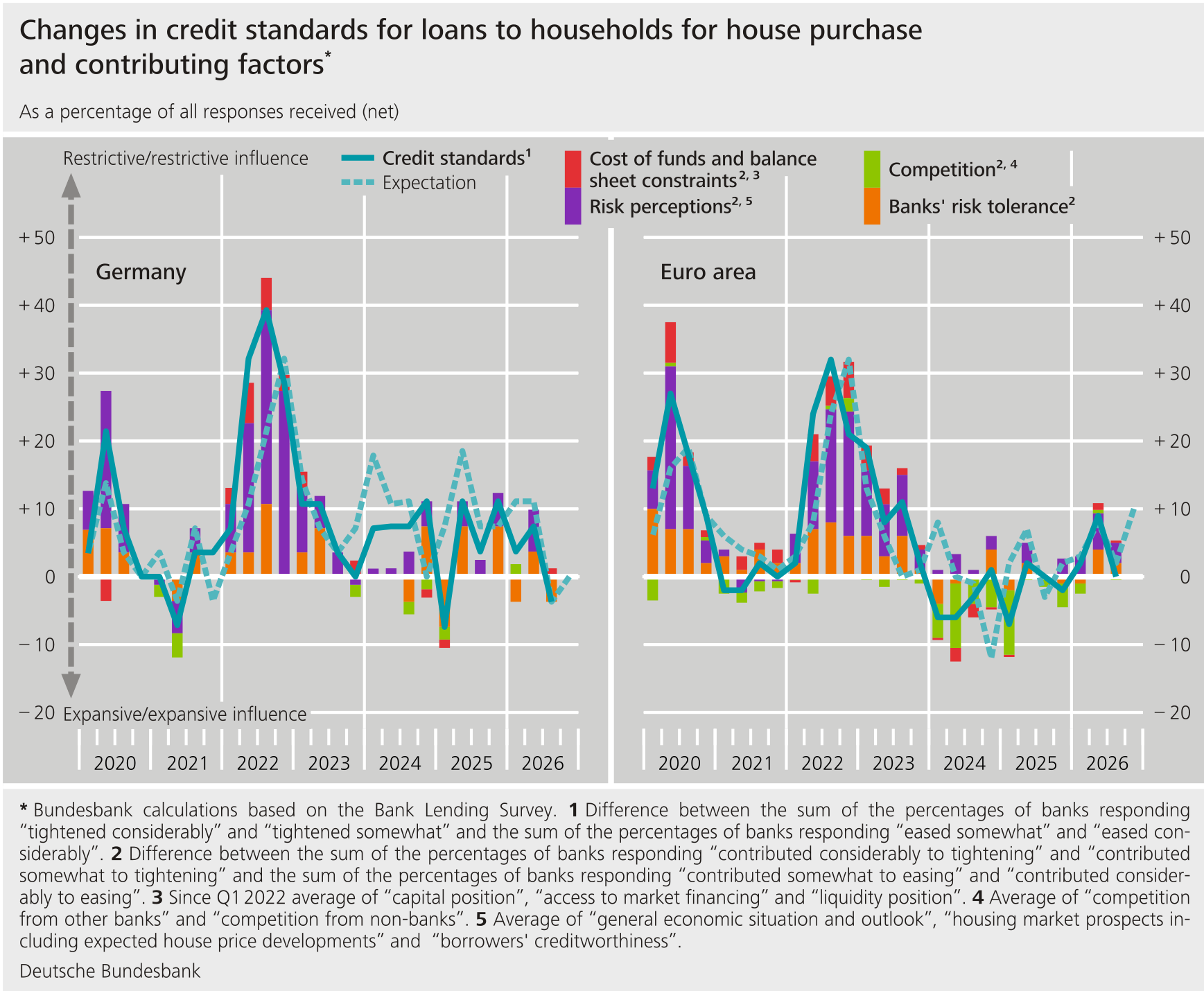
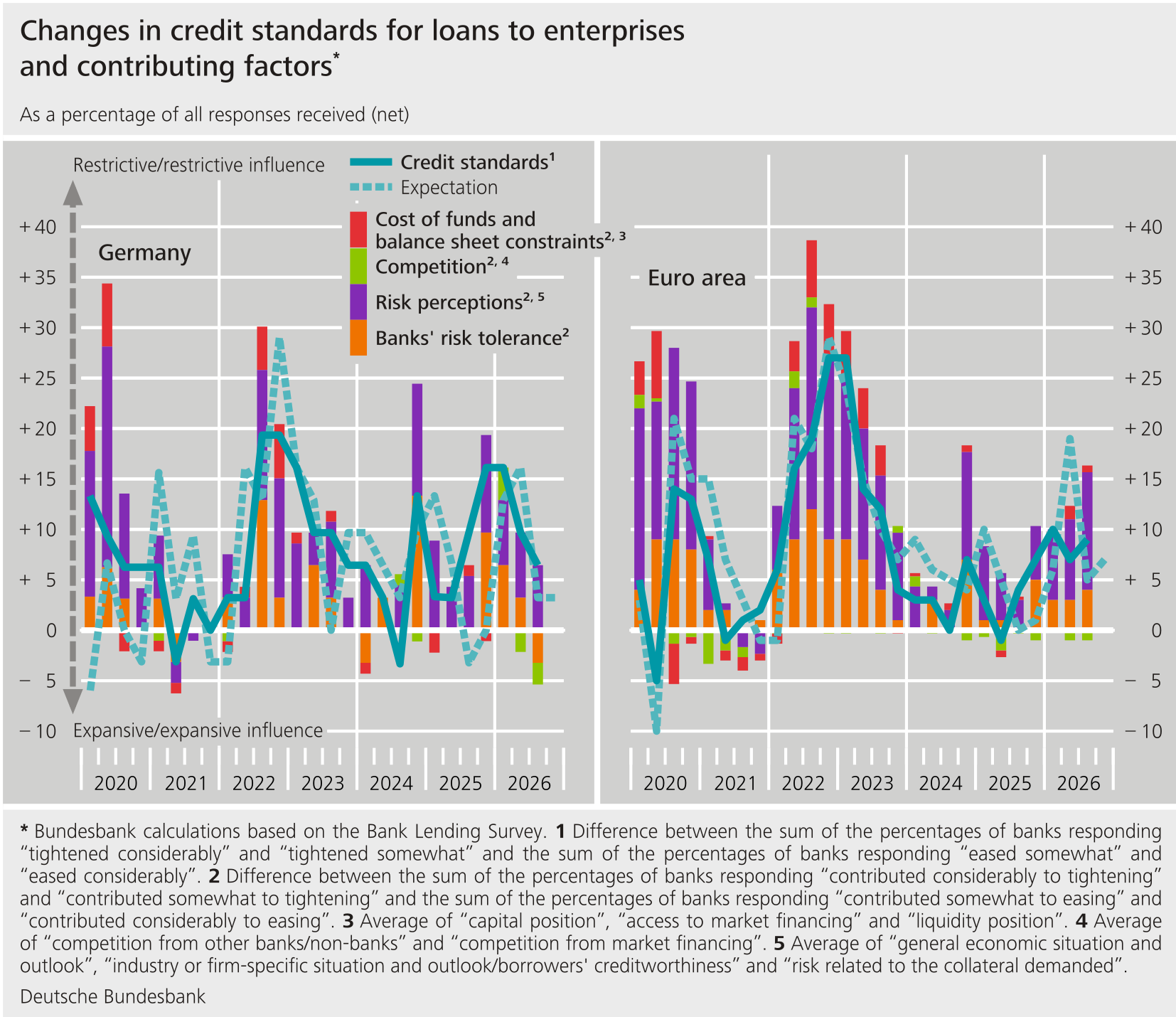
The BLS covers three loan categories: loans to enterprises, loans to households for house purchase, and consumer credit and other lending to households. On balance, the surveyed banks tightened their credit standards (i.e. their internal guidelines or loan approval criteria) for loans to enterprises. By contrast, they eased their credit standards for loans to households for house purchase. They did not change their credit standards for consumer credit and other loans to households. The net share of banks that tightened their standards stood at + 6 % for loans to enterprises (compared with + 10 % in the previous quarter). The net share of banks that tightened their standards for loans to households for house purchase was − 4 % (compared with + 7 % in the previous quarter); for consumer credit and other lending to households, this figure was 0 % (compared with + 11 % in the previous quarter). Banks tightened their credit standards for loans to enterprises to a somewhat greater extent than they had planned in the previous quarter. The easing of credit standards for loans to households for house purchase was consistent with plans from the previous quarter. On balance, banks did not tighten their standards for consumer credit and other lending to households, contrary to their plans.
The banks justified the tightening of their credit standards for loans to enterprises on the grounds of a perceived increase in credit risk. This assessment refers primarily to sector-specific and firm-specific factors as well as the subdued economic situation and outlook. By contrast, two factors, taken individually, had an expansionary impact on credit standards for loans to enterprises. As in the previous quarter, banks reported increasing competition in the banking sector. For the first time in more than two years, banks also reported a higher risk tolerance. In lending business with households, banks’ increased risk tolerance was the reason why credit standards were not tightened further. With regard to consumer credit and other lending, this expansionary factor was offset by a deterioration in households’ creditworthiness and the subdued economic situation, both of which jointly constricted lending. For the fourth quarter of 2026, banks are planning to make minor restrictive adjustments to their credit standards for corporate credit, consumer credit and other lending. Credit standards for loans for house purchase are set to remain unchanged.
On balance, banks in Germany tightened their terms and conditions (i.e. the terms and conditions actually approved as laid down in the loan contract) for loans to enterprises as well as for consumer credit and other lending. The restrictive adjustments in both loan categories are the outcome of higher lending rates and – with regard to loans to enterprises – an increase in margins for riskier loans. In the loan category of loans to households for house purchase, credit terms and conditions remained unchanged on balance.
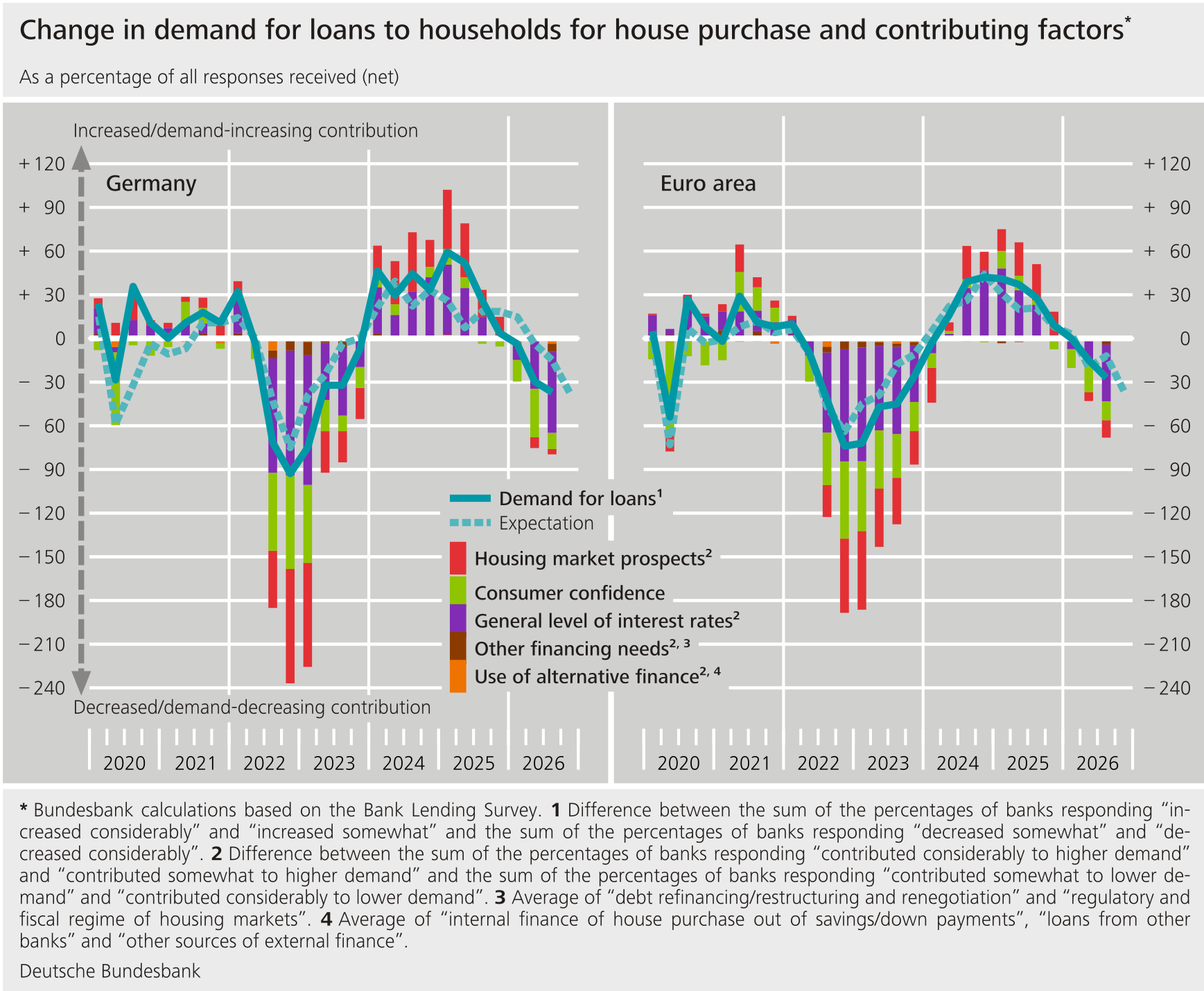
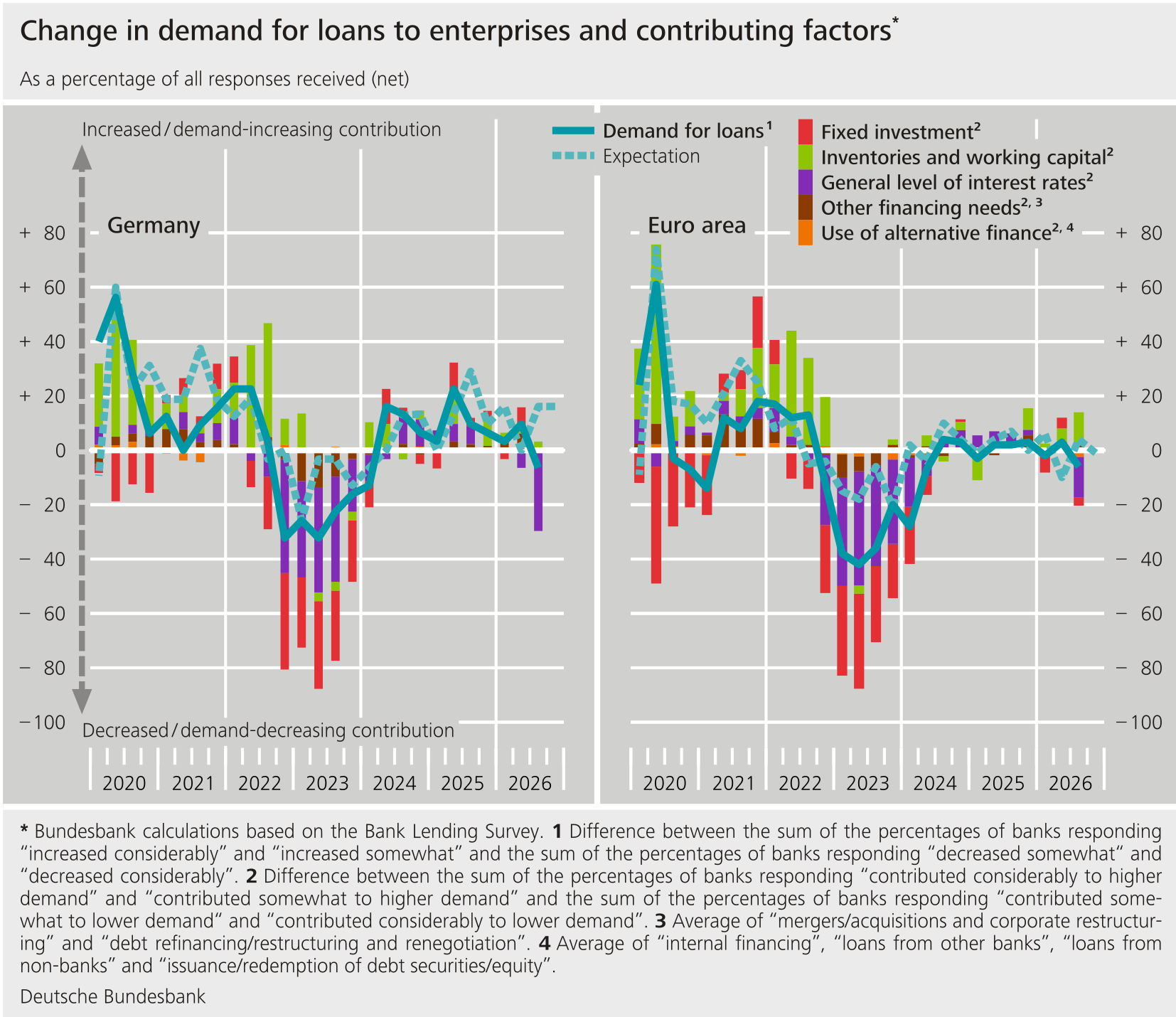
The surveyed banks assessed that demand for bank loans in Germany had decreased on balance for loans to enterprises as well as loans to households in the third quarter of 2026. For loans to enterprises, this was the first decline in more than two years. In the previous quarter, banks had still been expecting demand for bank loans to increase. The decline in demand mainly concerned small and medium-sized enterprises and long-term loans. The banks cited the higher general level of interest rates as the primary reason for the decline in demand. The interest rate level had a significantly stronger dampening impact than in the previous quarter. In contrast to the previous quarter, the banks reported that only financing needs for inventories and working capital, considered in isolation, had a positive impact on demand.
Households’ demand for loans for house purchase declined considerably for the second time in succession. By contrast, demand for consumer credit and other lending declined at a significantly weaker pace than in the two preceding quarters. The drop in demand for loans to households for house purchase surpassed banks’ expectations from the previous quarter. The decline in demand for consumer credit and other lending, however, was consistent with their expectations. Banks attributed the decline in household demand mainly to the higher general level of interest rates and weaker consumer confidence. The surveyed banks also suspected that households’ weak demand for loans for house purchase was due to an increase in demand for loans from competing institutions. Banks cited refinancing/debt restructuring and renegotiation as another factor dampening demand. The loan rejection rate continued to rise in all three loan categories. In business with enterprises, banks are expecting demand to pick up in the fourth quarter of 2026. By contrast, in business with households, banks are expecting a further decline in financing needs.
The October survey round contained ad hoc questions on participating banks’ financing conditions and about the impact of non-performing loans (NPLs) and other indicators of credit quality on the institutions’ lending policies. It also contained questions about the impact of the Eurosystem’s monetary policy asset portfolios and of digital assets on institutions’ financial situation, business strategy, and credit standards.
Given the conditions in financial markets, German banks reported a slight deterioration overall in their funding situation. Access to customer deposits, in particular, deteriorated, as did money market-based and debt securities-based funding.
In the third quarter of 2026, the NPL ratio (the stock of gross NPLs on the bank’s balance sheet as a percentage of the gross carrying amount of loans) and other indicators of credit quality had – owing to their levels – a tightening impact on credit standards, particularly those for loans to enterprises. For the fourth quarter of 2026, too, the banks are expecting credit quality primarily in the category of loans to enterprises to have a restrictive effect on their credit standards.
Over the past 12 months, the reduction in the Eurosystem’s monetary policy asset portfolio played a part in the increase in the stocks of euro area government bonds held by banks in Germany. In addition, the reduction, in and of itself, had a positive impact on their profitability, as it contributed to an increase in net interest income. The banks reported that the reduction in the size of the Eurosystem’s portfolio had not impacted notably on their financing conditions or capital ratio.
According to banks, digital assets have had no impact on their financial situation, business strategy or credit standards over the past 12 months. They do not expect any noteworthy effects over the coming 12 months, either. Only in terms of their strategic orientation are banks planning to open up new business areas in the field of digital assets.
The Bank Lending Survey, which is conducted four times a year, took place between 21 September and 6 October 2026. In Germany, 33 banks took part in the survey, with a response rate of 100 %.