
Non-performing loans in Germany: Weak economic developments, structural factors and higher interest rates feeding through to credit risk
Against the backdrop of the weak economic developments in recent years, structural adjustments and higher interest rates across the board, the debt servicing capacity of individual borrowers is being increasingly stressed. Accordingly, the share of non-performing loans in German institutions’ lending (NPL ratio) has risen in recent years from 1.3 % at the end of 2022 to around 2.0 % at the end of 2025. It has held steady at this level since the beginning of 2026. However, the aggregate ratio shows only an incomplete picture, as the trajectory of risks differs across groups of institutions and portfolios. The number of institutions with elevated NPL ratios rose further as well in the first half of the year from its end-2025 level.
Exposures are said to be non-performing if, for instance, they are more than 90 days past due or unlikely to be fully repaid. The stock of non-performing loans is typically referred to as a percentage of total lending. Known as the NPL ratio, it is an important indicator of the quality of a loan portfolio. Among other things, it indicates a potential future need for impairment, restructuring and resolution. However, as a backward-looking indicator, it does not intrinsically have sufficient power to predict how the part of the loan portfolio that is not currently non-performing will evolve.
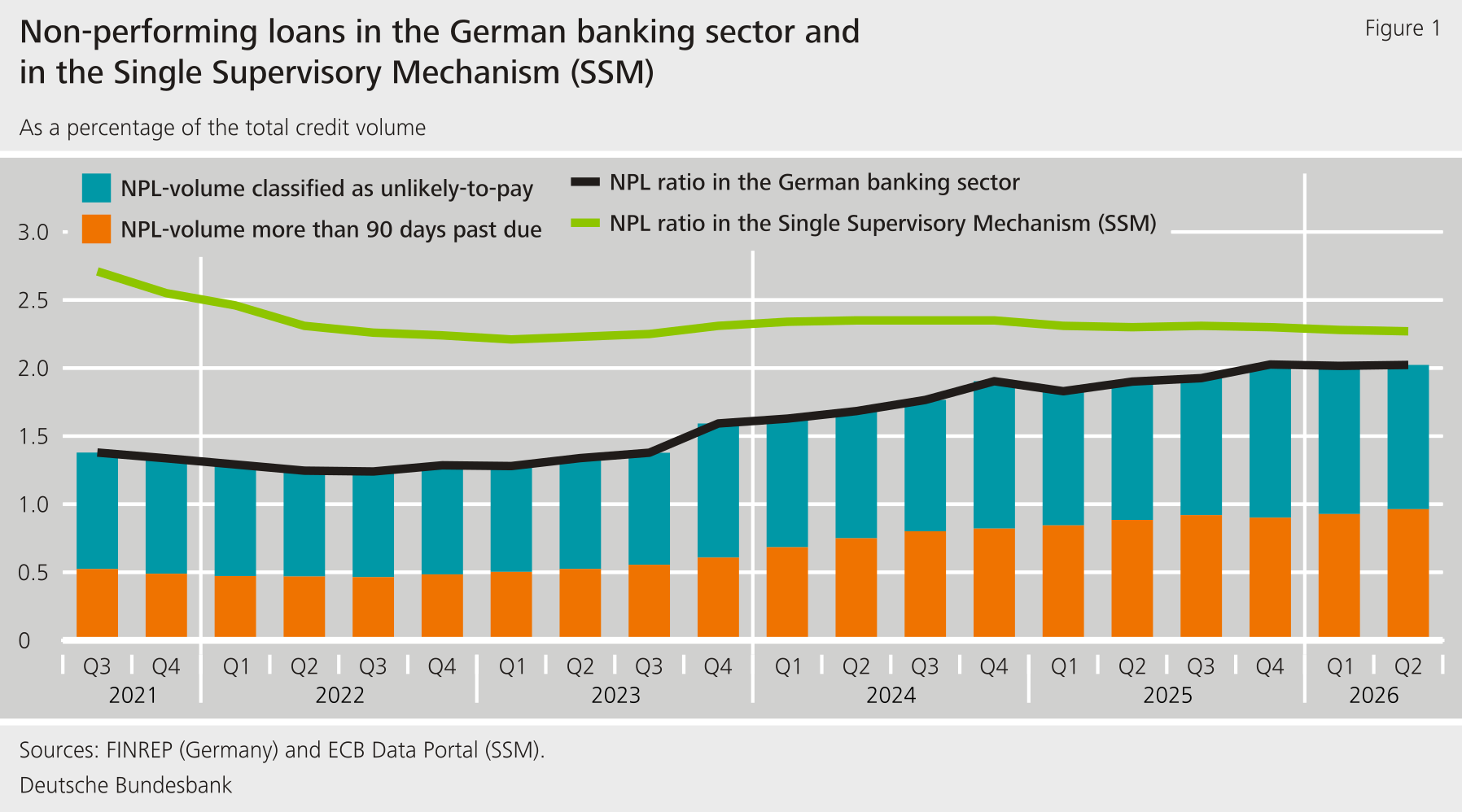
The average NPL ratio in the German banking sector rose from 1.3 % in 2022 to around 2.0 % at the end of 2025. Since then, it has remained broadly unchanged (Fig. 1). Despite the relatively stable ratio, the aggregate volume of NPLs increased in the first half of 2026. The composition of this recent increase in NPLs is striking. It was exclusively attributable to loans that were more than 90 days past due. Their share of the total NPL volume thus came close to its seven-year high.
In a European comparison, the development of NPL ratios in Germany is notable. It is not so much the current level that warrants increased attention but the developments observed in recent years. While the NPL ratio has been relatively stable on average across all institutions supervised by the Single Supervisory Mechanism (SSM) since the end of 2022, or has only fluctuated slightly, the gap between the SSM average and Germany has closed almost completely. At around 2.3 % (green line in Fig. 1), the SSM average is now only slightly above German institutions’ ratio.[1] This is also a reflection of the fact that countries whose non-performing loans had reached historically high levels, partly as a result of the financial and euro crises, have now made major progress in reducing NPLs.
When comparing the level and development of NPL ratios in Germany across groups of institutions, it becomes clear that the NPL ratios of significant institutions (SIs[2]) and less significant institutions (LSIs) have been broadly stable at different levels since the beginning of the year. The ratio was 1.9 % for SIs in the second quarter of 2026 and 2.4 % for LSIs. Developments continued to vary across LSIs. At 2.2 %, savings banks’ overall NPL ratio has remained broadly constant since the end of 2025. By contrast, cooperative banks’ NPL ratio increased by 8 basis points to 2.7 % over the same period (Fig. 2). At the end of 2023, the average NPL ratios of both groups of institutions were still on a par with one another.
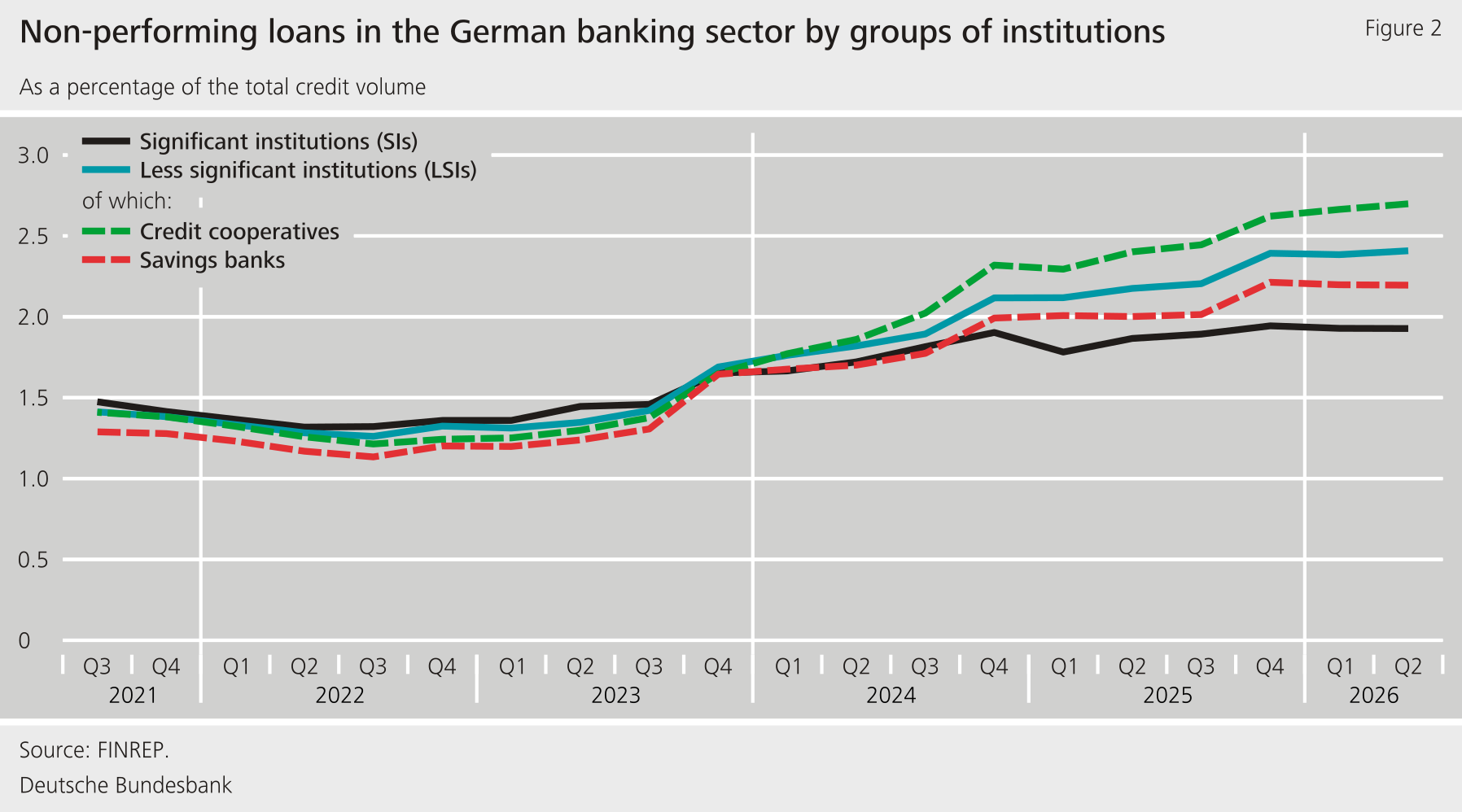
Although the overall trend was stable, the number of institutions with an NPL ratio of at least 5 % rose further in the second quarter of 2026 to 71 institutions. This means that the number of institutions above this threshold has nearly tripled since the end of 2022. It is also striking that the dispersion of NPL ratios within the cooperative banking network is more pronounced than among savings banks.
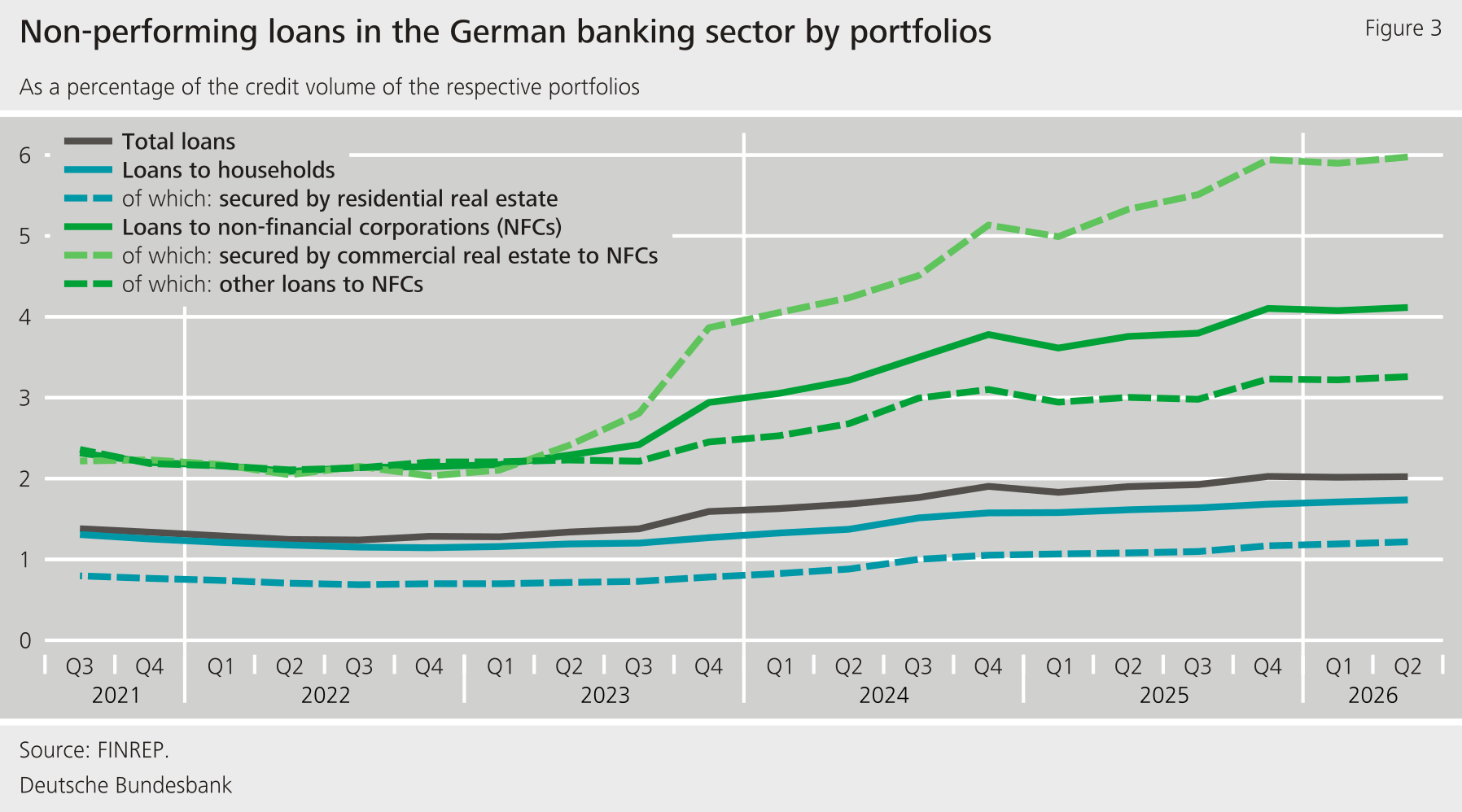
Corporate financing and commercial real estate remain particularly relevant. After having previously increased, the NPL ratio for loans to non-financial corporations remained relatively constant in the first half of 2026 at around 4.1 % (Fig. 3). For corporate loans secured by commercial real estate, the NPL ratio last stood at 6.0 %. It has thus increased only marginally since the end of 2025, yet remains well above the level of previous years. By contrast, the NPL ratio for loans to households is still comparatively low at around 1.7 %, but has also risen slightly recently. For loans secured by residential real estate, it stood at 1.2 %. As residential real estate loans are of relatively great importance in the German banking system, even small changes in the NPL ratio for such loans can lead to distinct absolute changes in the NPL volume.
From a regulatory perspective, not only the level of non-performing loans, but also the provisioning held against NPLs is of significant importance. The NPL coverage ratio in the German banking sector stood at 35.0 % in the second quarter of 2026. In this context, reference should also be made to the NPE backstop[3], which, after a certain period of time, ensures sufficient minimum coverage for non-performing exposures or requires a deduction from Common Equity Tier 1 (CET1) capital if coverage is insufficient. The NPE backstop thus contributes to appropriate risk provisioning.
For institutions, the early identification and consistent management of non-performing exposures remains a key prerequisite for effective credit risk management. The overall NPL ratio is stable at present, but this does not warrant giving the all-clear sign. The increase in past-due NPLs and the growing number of institutions with high NPL ratios demonstrate that forward-looking management of problem exposures remains essential. Credit institutions should have an appropriate framework to identify, measure, manage, monitor and effectively reduce non-performing exposures. A clearly defined governance structure, clearly assigned responsibilities, appropriate data and control processes and a robust operational structure are prerequisites for a sustainable solution to NPL problems. Early interventions, realistic collateral valuations, consistent restructuring decisions and sufficient staff expertise are key success factors in this regard.
Footnotes:
- A robust quantitative comparison is predicated on a uniform definition of the institutions and portfolios under review. For the German banking sector, all FINREP reporting institutions in Germany except for branches of foreign banks were used, including institutions not classified as either significant or less significant. The time series of the European Central Bank incorporates information from all supervised significant and less significant institutions of SSM countries.
- Including subsidiaries of foreign SIs.
- See Regulation (EU) 2019/630 of the European Parliament and of the Council of 17 April 2019 amending Regulation (EU) No 575/2013 as regards minimum loss coverage for non-performing exposures.