
High-frequency instruments with time-varying reliability: Understanding identification in macroeconomics Pooyan Amir-Ahmadi, Christian Matthes, Mu-Chun Wang
DOI: doi.org/10.71734/DP-2026‑8
Empirical macroeconomic research often uses high-frequency financial data to identify monetary policy shocks. This paper shows that the reliability of such instruments varies substantially over time. Recognizing this time variation reveals when the data genuinely inform us about policy actions – and when they do not. Accounting for these shifts sharpens estimates and alters the interpretation of how monetary policy affects inflation and output.
Why instrument reliability matters
Modern empirical macroeconomics frequently relies on external instruments to uncover the effects of economic shocks. For monetary policy, researchers often use high-frequency changes in asset prices around Federal Reserve’s announcements as instruments (e.g., Gertler and Karadi 2015). A central assumption is that the relationship between these asset price surprises and true policy shocks is stable over time.
Amir-Ahmadi, Matthes, and Wang (2026) challenge this view. Using data on three-month-ahead federal funds futures surprises, they show that the dynamics of this popular instrument change markedly across periods – notably in the early 1990s, 2001, and during the Great Recession. Such changes imply that the instrument’s ability to capture true monetary shocks is time-varying, not constant. Ignoring this feature can distort inference about the real effects of monetary policy.
A new econometric framework
We develop a Bayesian proxy VAR model that allows the relationship between the instrument and the monetary policy shock to vary over time. This model distinguishes between two potential explanations for changing instrument behavior:
Time-varying strength (preferred): The link between the instrument and the true policy shock fluctuates. Volatile periods convey more information.
Changing measurement noise: Volatile periods reflect less reliable data, dominated by noise.
Empirically, the first explanation fits the data much better. When the instrument’s relevance is allowed to vary, the estimated impulse responses are economically consistent. By contrast, treating volatility as pure noise leads to implausible results – for instance, prices rising after a monetary tightening.
What the data reveal
The analysis identifies only a few short episodes when high-frequency instruments are strongly informative about policy shocks:
Early 1990s: The post-recession period of high inflation and accommodative Federal Reserve’s policy.
2001: Intermeeting rate cuts during the early-2000s slowdown.
2008–09: The Great Recession and extraordinary monetary interventions.
Outside these episodes, the high-frequency surprises contain little useful information. Strikingly, when we set 90% of the instrument observations to zero – keeping only the identified “informative” periods – the estimated policy effects remain nearly unchanged.
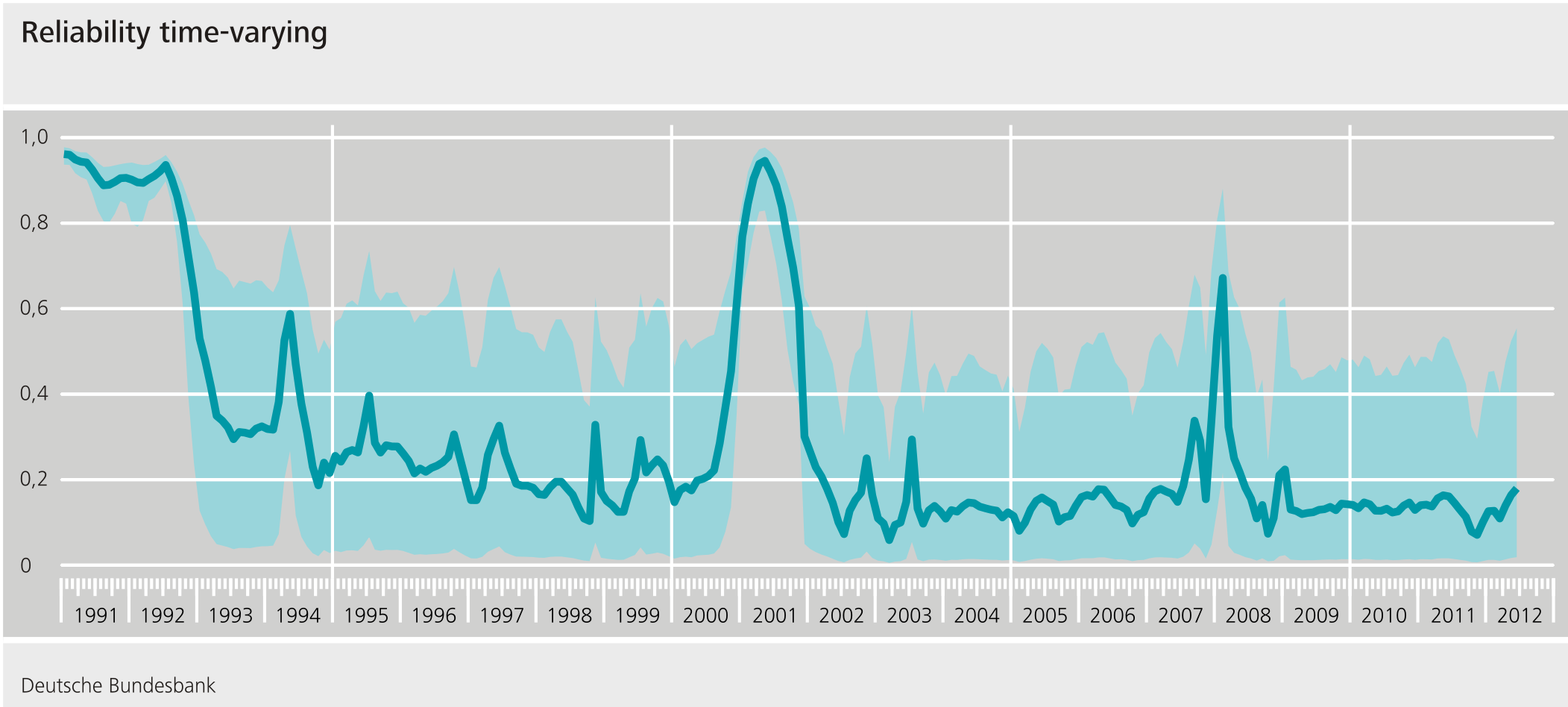
A chart illustrating three peaks in instrument reliability corresponding to the early 1990s, 2001, and 2008–09, with low reliability elsewhere. Solid line is the posterior median. Shaded is the 68% probability band.
Clearer effects of monetary policy
Taking time variation into account changes empirical conclusions. The effect of a monetary tightening on prices is roughly 50% larger than in the constant-coefficient benchmark, and the notorious “price puzzle” – where prices initially rise after a rate hike – disappears. These improvements in interpretability come without an increase in statistical uncertainty.
In essence, most of the information used for identifying policy shocks stems from a few well-defined historical episodes. Recognizing when instruments are reliable allows researchers to build a more coherent narrative of identification.
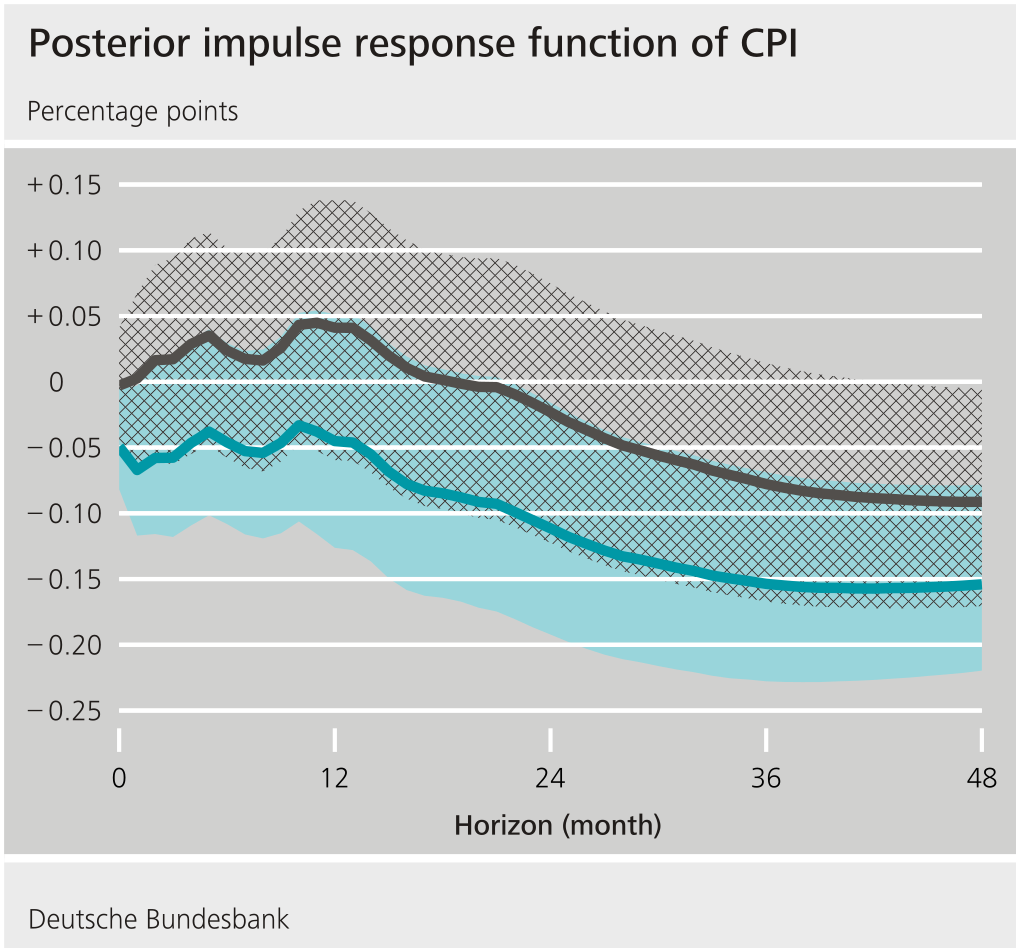
Two lines compare the price response under (i) a fixed-coefficient model (gray) and (ii) a time-varying instrument reliability model (blue). The blue line shows a larger and more persistent decline in prices after a rate hike. Solid line is the posterior median. Shaded is the 68% probability band.
Broader implications
The proposed approach provides a general framework for improving inference whenever instruments are used to identify economic shocks – not only in monetary policy, but also in analyses of fiscal or financial shocks. By emphasizing periods when instruments are genuinely informative, the method enhances both the precision and credibility of empirical macroeconomic results.
References
Gertler, M., and Karadi, P. (2015). Monetary Policy Surprises, Credit Costs, and Economic Activity. American Economic Journal: Macroeconomics, 7(1), 44–76.
Pooyan, A.-A., C. Matthes, M.-C. Wang (2026), High-frequency instruments with time-varying reliability: Understanding identification in macroeconomics, Bundesbank Discussion Paper, No 08/2026.
4 MB, PDF