
Monetary policy and the added worker effect John Leahy, Tereza Ranošová
DOI: doi.org/10.71734/DP-2026-2
When married women have weak ties to the job market, they can flexibly enter and exit employment to supplement household income during economic downturns. This provides powerful insurance against income shocks at the household level. When married women are always working, this insurance mechanism is absent. We show that in this case monetary policy has a stronger impact on the economy, with aggregate employment responding more sharply to interest rate changes.
The "added worker effect" – where non-working women time their labor supply to when their household loses income – has been well documented at the household level (Lundberg 1985, Stephens 2002). However, its macroeconomic implications are less explored. This question has become increasingly relevant as married women's attachment to the labor market has strengthened dramatically over the 20th century. As women have become more permanently employed, their ability to flexibly enter the workforce during downturns has diminished, weakening this insurance mechanism. Using a panel of US states from 1990 to 2008, we examine how the response of employment and payroll to high-frequency monetary policy surprises depends on whether the added worker effect is active.
Monetary policy has greater impact when married women work
Our baseline results reveal a striking pattern: monetary policy shocks have a greater impact on employment and payroll in states in which a higher share of married women were employed before the shock. We measure this using the employment rate of married women relative to the overall employment rate in each state, which helps control for factors that affect employment of all demographic groups.
Figure 1 presents our key finding: the difference between two employment responses to a contractionary monetary policy shock. To compute this difference, we compare a (hypothetical) state with the average share of married women working to a (hypothetical) state where that share is one percentage point higher, and subtract the latter’s response from the former’s. When the share of married women working increases by one percentage point, the response of employment to a contractionary monetary policy shock becomes more negative by about 1 percentage point at its peak, with effects persisting for over three years.
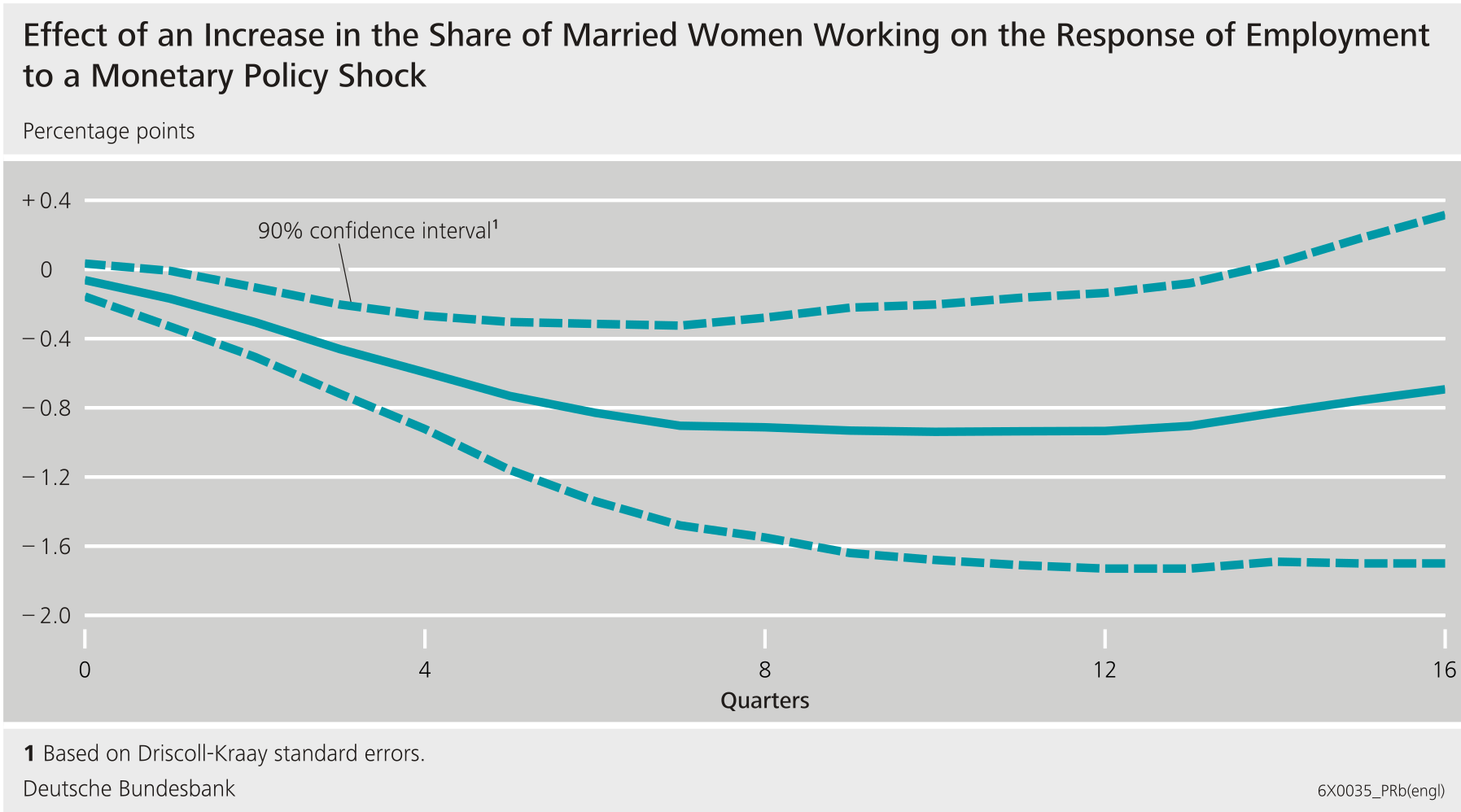
Monetary policy has greater impact when married women are more strongly attached to jobs
We provide additional evidence for our mechanism by examining how attached married women are to the labor market across states. We measure attachment by the number of transitions between employment, unemployment and being out of the labor force. We find that married women make more job transitions in states where fewer married women typically work, indicating weaker labor market attachment.
Consistent with our hypothesis, states where married women are more marginal – making more transitions between labor market states – exhibit weaker responses to monetary policy shocks. This supports the idea that when married women are loosely attached to the labor market, they can more flexibly adjust their work decisions to provide insurance against economic shocks.
Individual behavior confirms the added worker effect
Our individual-level analysis using Current Population Survey data confirms the aggregate patterns. After monetary policy tightening, married women are more likely to be employed and to enter employment in states where the share of married women working is typically low. We also find that wages of married women fall more in states where married women typically have lower employment rates. This is consistent with the added worker effect being fundamentally a labor supply response: as married women enter the workforce to maintain household income, they increase labor supply and put downward pressure on wages.
Policy implications for a changing economy
Our findings have important implications for monetary policy as women's labor force participation has increased substantially over recent decades. The results suggest that as married women become more firmly attached to the labor market, the economy becomes more sensitive to monetary policy shocks because the added worker effect – a traditional source of household insurance – weakens. This provides empirical support for the theoretical argument made by Casella (2022), who argues that women have become more firmly attached to the labor market over time, muting the added worker effect and making the economy more cyclically sensitive.
Our research suggests that the historical convergence between male and female employment patterns has made the real economy more sensitive to monetary policy. This implies that central banks may need to recalibrate their expectations about monetary policy effectiveness as demographic patterns continue to evolve. The research also highlights that the composition of the workforce matters for policy transmission, adding to our understanding of why monetary policy effects vary across time and regions.
References
Casella, S. (2022). Women's labor force participation and the business cycle. Working Paper.
Gurkaynak, R. S., B. P. Sack, and E. T. Swanson (2005). Do actions speak louder than words? The response of asset prices to monetary policy actions and statements. American Economic Review 95(2), 425‑447.
Lundberg, S. (1985). The added worker effect. Journal of Labor Economics 3(1), 11‑37.
Stephens, M. (2002). Worker displacement and the added worker effect. Journal of Labor Economics 20(3), 504‑537.
Leahy, J., T. Ranošová (2026), Monetary policy and the added worker effect, Bundesbank Discussion Paper, No 02/2026
1 MB, PDF