Peering beyond the veil: A dissection of aggregate bank lending rate movements into pricing and composition effects using credit-level data Paul Reimers, Henrike Michaelis
DOI: https://doi.org/10.71734/DP-2025‑36
Compared to 2021, the aggregate bank lending rate to firms in the euro area increased significantly during the monetary policy tightening and easing cycle of 2022‑25. But the increase was up to 1.5 percentage points (PP) less than the rise in policy and money market rates. What explains the increase in the aggregate bank lending rate, and why did it not rise in lockstep? We approach these questions using granular credit registry data, revealing how changes in the composition and pricing of credit translate into developments in the aggregate rate and the gap. Composition effects were minor, while pricing effects were instrumental in opening the gap. The key individual factor opening the gap was that banks' fixed components of credit pricing increased less than the 3-month (3M) Euribor, signaling an incomplete pass-through of changes in refinancing costs. However, changes in mark-ups (i.e. in premia and discounts) also played a critical role, counteracting the incomplete pass-through and reducing the gap.
In comparison to 2021, policy and money market rates increased by up to 4.5 PP during the 2022‑25 monetary policy tightening and easing cycle. However, the aggregate bank lending rate to firms in the euro area increased by only by up to 3 PP. Policymakers observed this increase closely to assess the strength of monetary policy transmission via banks and to avoid an over-tightening of monetary policy. Until recently, the lack of credit-level data hindered efforts to better understand how developments of the aggregate bank lending rate are shaped from micro-level developments.
We use AnaCredit to tackle this and decompose the differential increase between the aggregate bank lending rate and the 3M Euribor into ‘composition’ and ‘pricing’ effects. Composition effects arise because ‘which banks’ financed ‘which firms’ and ‘how’ changed compared to 2021 Pricing effects are due to changes in how banks priced credit during 2022‑25. They arise from two factors: The extent to which banks passed through their higher refinancing costs, and adjustments that banks made to the discounts and premia they use to account for firm and credit characteristics. To separate composition from pricing effects, we implement a decomposition technique that is standard in the labor literature. We show how to use it to decompose the development of aggregate variables over time and are the first to do so in the loan pricing literature.
Pricing effects are key to understanding why the gap opened up
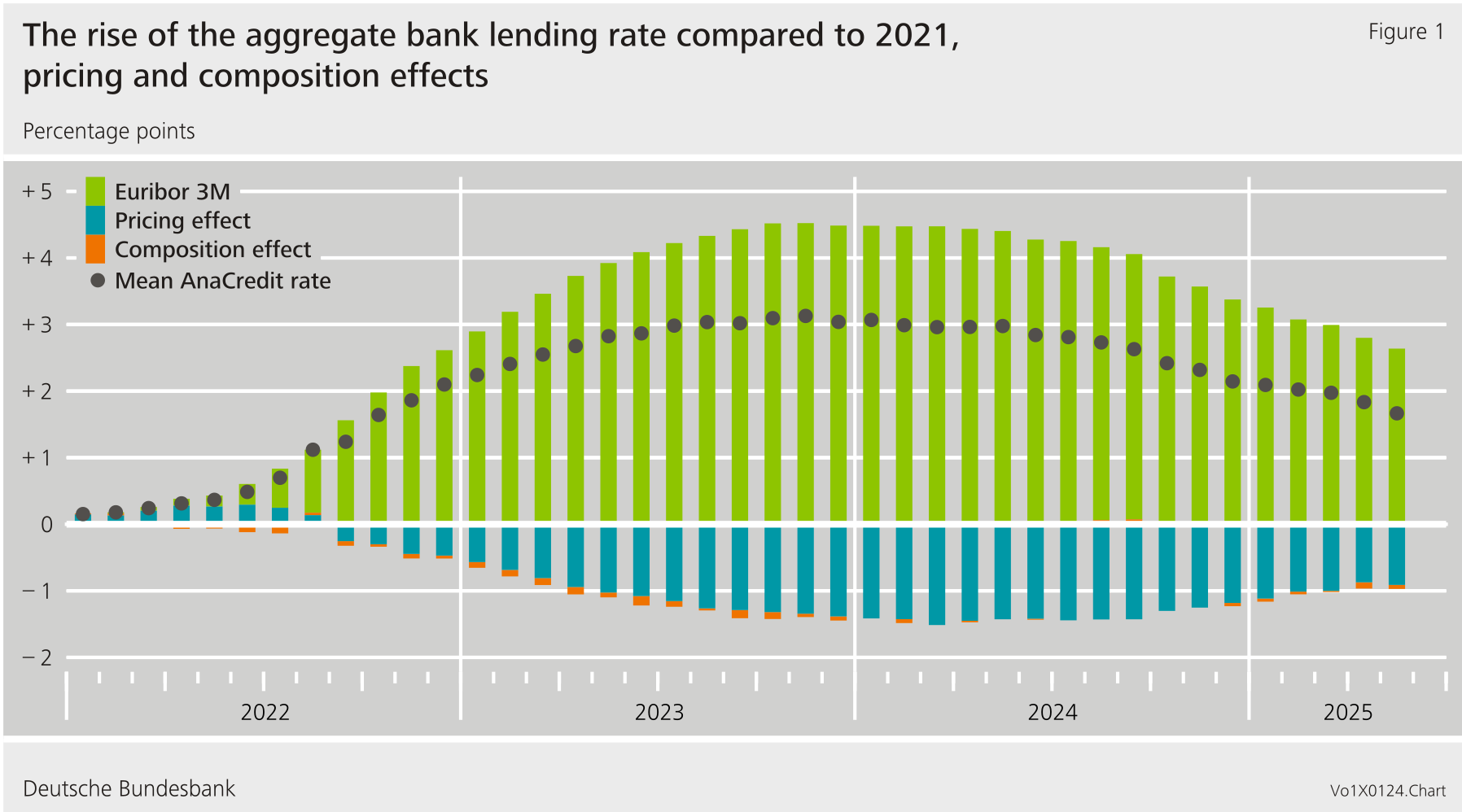
Composition effects were minor, while pricing effects were instrumental in opening the gap. Figure 1 makes this apparent in form of the negative blue and orange bars. Combined, these bars sum up to explain the difference between the increase in the aggregate bank lending rate (dots) and the increase in the 3M Euribor (green bars). The blue bars indicate that the aggregate rate would have risen by up to 1.5 PP more if credit pricing had remained as in 2021. Similarly, the increase in the aggregate rate would have been up to 0.15 PP higher if the composition of lending had remained as in 2021 (orange bars).
The decomposition along individual contributors reveals that the gap was shaped by an incomplete pass-through of refinancing costs and adjustments in mark-ups, such as higher costs for larger credit amounts and specific instruments
The decomposition allows us to delve deeper, identifying individual contributors to the pricing effect. We find that banks adjusted their fixed components of credit pricing by less than the increase in the 3M Euribor, which was a key factor behind the opening of the gap. According to the literature, banks adjust their fixed components of credit pricing to pass through changes in refinancing costs, but this pass-through tends to be incomplete. Therefore, the opening of a gap is not entirely surprising. However, the lesson learned from our decomposition is that the transmission of monetary policy to bank lending rates involves more than just a passing through of refinancing costs: Changes in mark-ups (i.e. in premia and discounts) also played a critical role in the gap. In particular, larger credit amounts and certain instrument types became more expensive compared to 2021, exerting upward pressure on the aggregate rate (up to + 1.3 PP and + 0.25 PP, respectively). Without such adjustments, the gap would have amounted to up to 2.25 PP, rather than 1.5 PP.

Conclusion
Overall, we show that monetary policy impulses were transmitted to bank lending rates differently depending on the type of firm and financing arrangement, and our micro-insights complement macro-based approaches to better understand how compositional shifts and pricing changes shape aggregate interest rate pass-through patterns. We emphasize the importance of building historical evidence on the contributions of compositional shifts and pricing changes to the development of the aggregate bank lending rate and the gap. Such historical patterns would be very valuable, for example for policymakers when calibrating monetary policy and assessing the strength of monetary policy transmission.
Reimers, P., H. Michaelis (2025), Peering beyond the veil: A dissection of aggregate bank lending rate movements into pricing and composition effects using credit-level data, Bundesbank Discussion Paper, No 36/2025.
9 MB, PDF