Foreign direct investment stock statistics in 2023
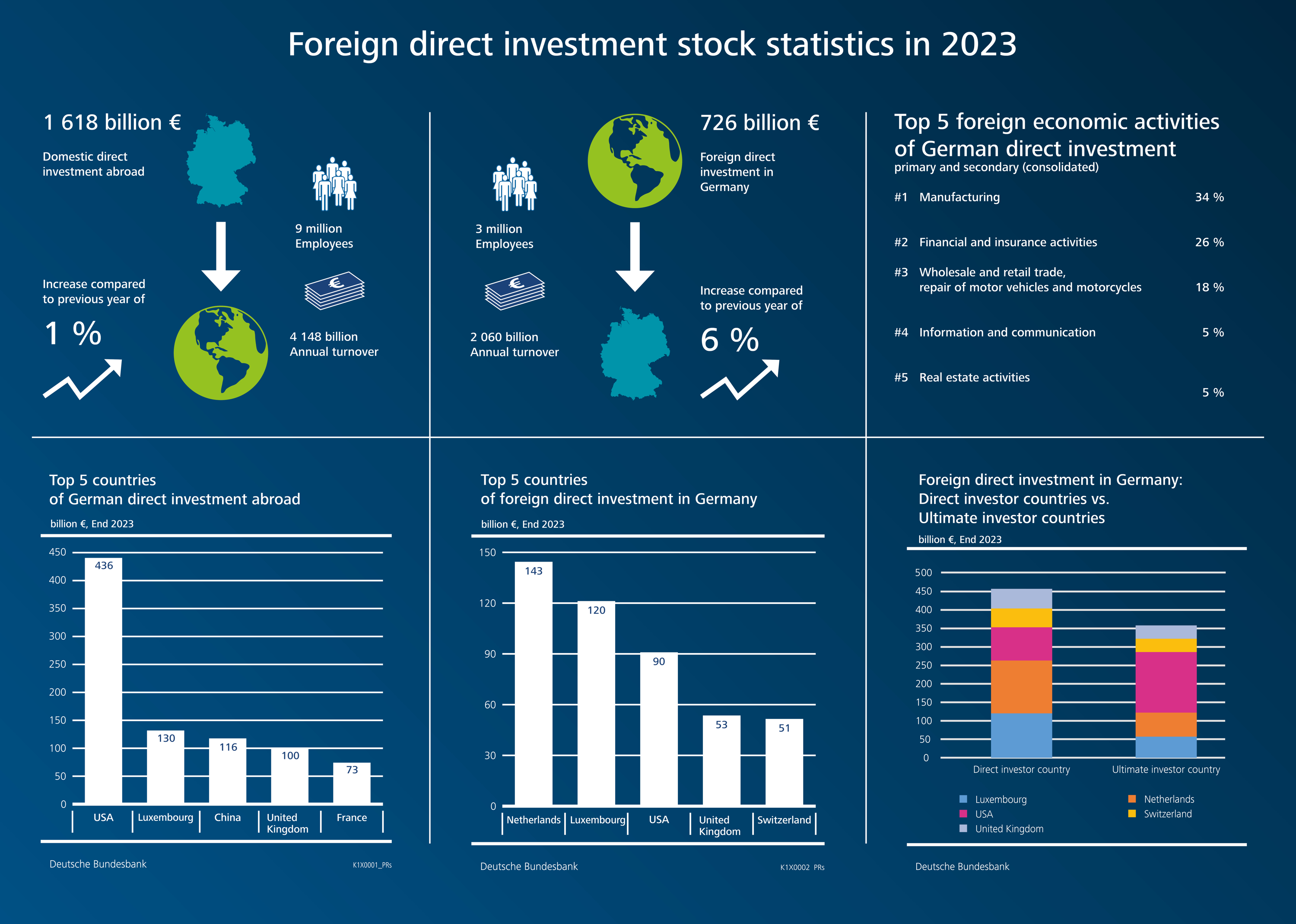
At year-end 2023, Germany’s primary outward foreign direct investment (FDI) stocks were up only marginally on the end of 2022 in net terms, rising from €1,694 billion to €1,701 billion. In particular, the appreciation of the euro – coupled with corresponding negative exchange rate effects – played a part in dampening the small increase in stocks. As in the previous years, equity capital accounted for the bulk of Germany’s primary outward FDI, at €1,851 billion. German investors’ foreign credit positions reduced the direct investment stocks by €150 billion on balance, as claims of €433 billion were outweighed by liabilities of €583 billion.
In the fourth quarter of 2024, German households’ nominal financial assets grew by €136 billion, totalling €9,050 billion as at the end of the year. This is now the fifth increase in succession, continuing the growth streak that has been ongoing since the end of 2023. Households increased their claims by €79 billion and generated valuation gains of €57 billion.
The German current account recorded a surplus of €20.0 billion in February 2025, up €5.0 billion on the previous month’s level. The surplus in invisible current transactions, which comprise services as well as primary and secondary income, declined slightly. However, the surplus in the goods account rose even more strongly.
General government debt in Germany increased by €57 billion in 2024 to €2.69 trillion. Central government debt grew the most, by €36 billion. State and local governments recorded an increase of €15 billion and €14 billion, respectively.
Germany’s current account recorded a surplus of €11.8 billion in January 2025, down €9.1 billion on the previous month’s level. This was attributable to a lower surplus in the goods account and especially in invisible current transactions, which comprises services as well as primary and secondary income.
By way of majority, the National Cash Forum advocates rounding up or down to the nearest 5 euro cent for cash payments in Germany. The Federal Ministry of Finance is called upon to advocate for, and press ahead with, a binding statutory rounding rule in Germany. The rounding rule should be applied across Europe as uniformly as possible.
The Bundesbank is expanding its reform proposals for central government’s debt brake, laying out a stability-oriented path towards increased government investment. It is thus presenting a concept that supports the necessary measures to strengthen infrastructure and defence whilst ensuring sustainable public finances over the long term, in line with European rules.
As in 2023, the monetary policy measures of the past few years shaped the Bundesbank’s annual accounts in the 2024 financial year. For the reporting year, it has recorded an accumulated loss of €19.2 billion.
In 2024, the Bundesbank registered approximately 72,400 counterfeit euro banknotes with a nominal value of €4.5 million in German payments. The number of counterfeits was thus up by 28% on the year.
Germany’s current account recorded a surplus of €24.0 billion in December 2024, up €2.1 billion on the previous month’s level. The surplus in the goods account decreased sharply, but the surplus in invisible current transactions, which comprise services as well as primary and secondary income, increased more strongly.
German banks tightened credit standards for loans to enterprises, loan to households for house purchase, and for consumer credit and other lending to households in the fourth quarter of 2024. Loan demand increased further in all loan categories, especially for loans to households for house purchase.
In the third quarter of 2024, German households’ financial assets grew by €197 billion, closing the quarter at a new record high of €9,004 billion. This is a continuation of the uninterrupted growth trend that has lasted since end-2023.
Germany’s current account recorded a surplus of €24.1 billion in November 2024, up €10.4 billion on the previous month’s level. This was caused by a larger surplus in the goods account and especially by the shift to a surplus in invisible current transactions, which comprise services as well as primary and secondary income.
The Deutsche Bundesbank calculates the basic rate of interest pursuant to Section 247(1) of the German Civil Code (Bürgerliches Gesetzbuch) and publishes its current level in the Federal Gazette (Bundesanzeiger) pursuant to Section 247(2) of the German Civil Code.
Paying with cash or a debit card is the cheapest payment method for consumers in Germany. Cash incurs the lowest costs per payment transaction, while debit cards are cheapest in relation to the amount of money spent. Paying with a credit card is in any case considerably more expensive. These are the conclusions drawn by a study entitled “Costs of cash and card payments from a consumer perspective”, which was carried out on behalf of the Deutsche Bundesbank.
Germany’s current account recorded a surplus of €12.5 billion in October 2024, down €8.8 billion on the previous month’s level. This was caused by the smaller surplus in the goods account and especially by the shift to a deficit in invisible current transactions, which comprise services as well as primary and secondary income.
The National Cash Forum, initiated by the Deutsche Bundesbank in February 2024, has launched a new website to serve as a neutral source of information on all aspects of cash.