
Monetary policy, fragility, and fund flows Falko Fecht, Moritz Kellers
DOI: doi.org/10.71734/DP-2026‑9
Unexpected monetary policy tightening leads to significant outflows from German open-end investment funds. Outflows are not evenly distributed: those funds, whose investors are excessively flighty following bad fund performance, experience markedly stronger reactions. These so-called fragile funds meet redemptions by running down bank deposits. Moreover, their customers’ withdrawals reallocate deposits across banks. Fund fragility therefore plays an important role in how monetary policy propagates through market-based finance and the banking sector.
Introduction
Open-end investment funds (OEIFs) are collective investment vehicles, whose managers usually invest in securities and other assets on behalf of their shareholders. Retail fund investors such as households can buy and redeem their shares daily. This open-end structure makes investment funds inherently fragile, as poor performance can cause panic-induced fund share redemptions (Chen et al., 2010). Despite having grown substantially since the Global Financial Crisis, little is known about OEIFs’ role in the transmission of monetary policy. This is what we study in this paper, which was conducted as part of the ChaMP Research Network.
Using granular fund data together with unexpected ECB monetary policy changes, we quantify the heterogeneous reactions of funds, in particular fragile ones, to monetary tightening shocks and study their further implications for fund portfolios and the banking sector.
Fragile funds have disproportionately depressed net flows after monetary tightening
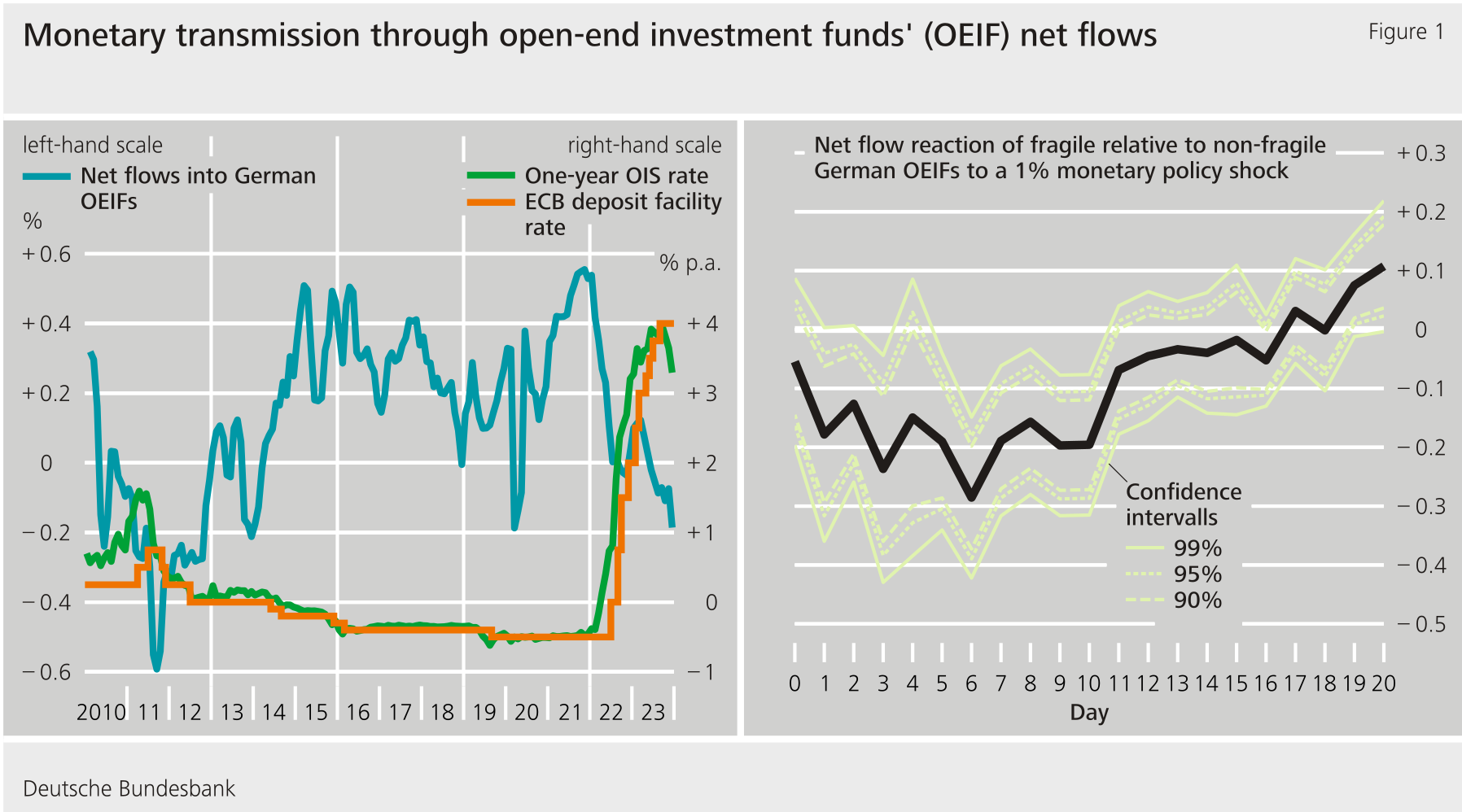
Flows into the OEIF sector are responsive to changes in monetary policy (expectations). As shown in Figure 1 (left panel), aggregate net inflows into German OEIFs dropped markedly during the ECB’s fast-paced interest rate hiking cycle in 2022–23, from about 0.5 % to − 0.2 %. To examine how individual fund fragility drives this pattern, we identify funds with high fragility potential based on the degree of fund investors’ overreaction to temporary underperformance, as opposed to overperformance, in the spirit of Goldstein, Jiang and Ng (2017).
Reactions of fragile fund net flows to the surprise component of monetary policy decisions over the days following the ECB Governing Council show that fragile funds experience substantially stronger declines in their net inflows after an unexpected tightening than non-fragile funds. We find that, in response to a 10 basis point (bp) surprise increase in interest rates, fragile funds experience a 0.2 percentage point (pp) larger outflow than non-fragile funds (Figure 1, right panel) – their total effect is about three times the response of their peers and of economically meaningful size.
This finding has important policy implications: In light of the increasing importance of OEIFs, the strength of monetary policy transmission depends on their (perceived) fragility. A declining share of fragile funds, e.g. due to macroprudential regulation of OEIFs or direct central bank access, can dampen this channel.
Fragile funds adjust portfolios and bank deposits
We next examine whether these outflows propagate monetary shocks further through the financial system. First, among bond funds – where corporate bond holdings are concentrated – fragile funds cut their corporate bond exposures more sharply, by roughly 0.5 pp following a 10 bp shock. This implies that fund fragility amplifies monetary transmission to bond markets.
Second, we uncover a novel effect when studying how funds meet redemptions. While non-fragile funds increase their bank deposits after a monetary policy surprise, fragile funds draw down these deposits to meet elevated redemptions. Outflows of unsecured wholesale deposits from banks that serve especially fragile funds represent a spillover from funds to banks that may amplify the deposit channel of monetary policy (Drechsler, Savov and Schnabl, 2017), in which monetary tightening reduces the value of deposit-like claims and raises customers’ withdrawal incentives. Moreover, fragile funds also lower their overall liquidity ratios, making them more vulnerable to subsequent shocks and further accelerating spillovers to banks.
Redistribution of deposits across the banking sector
We then examine where the redeemed money goes. Banks whose customers are heavily invested in fragile funds receive significant overnight deposit inflows after monetary tightening as these clients temporarily park their redemption proceeds. This dampens the deposit channel at these (other) banks and suggests a reallocation of deposits within the banking sector. Banks with a large share of fragile funds' wholesale deposits experience deposit outflows while banks with substantial custodian business whose customers hold predominantly fragile fund shares benefit.
References
Chen, Q., Goldstein, I., and Jiang, W. (2010). Payoff complementarities and financial fragility: Evidence from mutual fund outflows. Journal of Financial Economics, 97(2):239–262.
Drechsler, I., Savov, A., and Schnabl, P. (2017). The deposits channel of monetary policy. The Quarterly Journal of Economics, 132(4):1819–1876.
Goldstein, I., Jiang, H., and Ng, D. T. (2017). Investor flows and fragility in corporate bond funds. Journal of Financial Economics, 126(3):592–613.
Jarocinski, M. and Karadi, P. (2020). Deconstructing monetary policy surprises – the role of information shocks. American Economic Journal: Macroeconomics, 12(2):1–43.
Fecht, F., M. Kellers (2026), Monetary policy, fragility, and fund flows, Bundesbank Discussion Paper, No 09/2026.
2 MB, PDF