
Method changes for the computation of households’ pension entitlements in the financial accounts Methodological notes
As part of the benchmark revision – a fundamental revision of statistical series – the new euro area harmonised pension fund statistics were incorporated into the financial accounts in October 2024. At the same time, the overall calculation of households’ pension entitlements (ESA[1] instrument F.63) vis-à-vis all other sectors was also fundamentally revised. The financial accounts can now be used to draw a detailed picture of the composition of households’ pension entitlements in Germany.
Households in Germany have various options for building up pension entitlements. The three-pillar model of retirement provision includes the compulsory public system, occupational pension schemes and individual pensions. They are recorded differently in the financial accounts.
The first pillar is the compulsory public pension scheme, which mostly consists of unfunded government pay-as-you-go systems (in particular the statutory pension insurance and civil servant pension schemes). However, due to their design (mandatory for those concerned, government-managed, and usually unfunded pay-as-you-go), these are considered to be social security pension schemes within the meaning of ESA 17.43 ff. The resulting entitlements are therefore not recorded in households’ financial assets.[2] However, public and church supplementary pension units (kommunale und kirchliche Zusatzversorgungseinrichtungen – KKZVEs) and pension schemes organised by professional associations (berufsständische Versorgungswerke – BVs) are also traditionally included in this pillar. KKZVEs and BVs are largely funded and self-managed. Entitlements from these are methodologically counted as households’ financial assets and recorded under instrument F.63. BVs and a part of KKZVEs are included in the pension fund statistics and can thus be incorporated directly into the financial accounts. Entitlements from the remaining KKZVEs must be estimated on the basis of historical information.
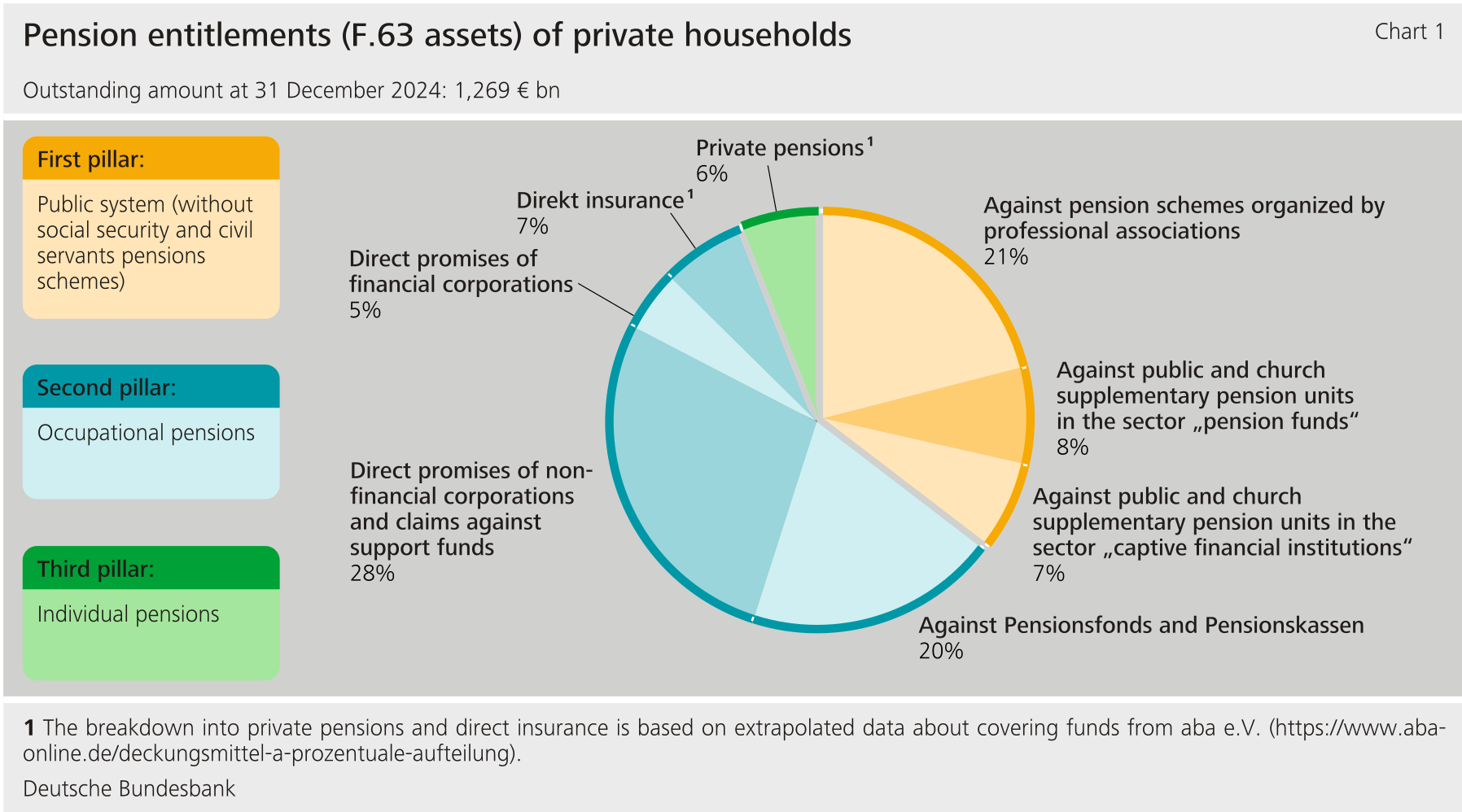
The second pillar of retirement provision in Germany consists of occupational pension schemes (betriebliche Altersversorgung – bAV). Employers can implement occupational pension schemes via five methods: Pensionsfonds,Pensionskasse,Unterstützungskasse (support funds), Direktzusage (direct promises) and Direktversicherungen (direct insurance). The implementation methods differ, in particular, with regard to their tax treatment, their functioning in the event of an employer’s insolvency, their transferability, their redemption modalities and their return. Households’ bAV entitlements are recorded under instrument F.63 in the financial accounts. When determining bAV entitlements, data from the German Pension Protection Fund (Pensions-Sicherungs-Verein) on both the reinsured volume of employer-provided pension commitments and the commitments of support funds are also used alongside the new statistics on pension funds. Direct insurance entitlements (including private pensions) are taken from the insurance statistics[3] of the European System of Central Banks. Within the insurance statistics, the format of the reports does not allow a distinction between direct insurance provided for employees via an employer (second pillar of retirement provision) and private pensions (third pillar of retirement provision). This breakdown between employer-provided and private insurance is not required for the purposes of financial accounting (see Figure 1 for an estimation of the breakdown).
Individual pensions are the third pillar of retirement provision in Germany. In particular, this pillar covers private pension insurance policies that households conclude with insurance companies on their own initiative. It also includes government-sponsored supplementary pensions (Riester pension plans and basic pensions). Although entitlements arising from these pensions undoubtedly count as household financial assets, they are recorded in the German financial accounts under the instrument that corresponds to their respective form of contract. For example, fund savings plans as part of Riester pension plans or basic pensions are recorded under investment fund shares and bank savings plans under deposits, meaning that neither are included under F.63. Figure 1, which only depicts pure pension entitlements (ESA instrument F.63), therefore includes only those Riester and basic pension entitlements that take the form of pension insurance schemes.
Most households’ pension entitlements are attributable to the various implementation methods used for occupational pension schemes. Figure 1 shows the structure of households’ pension entitlements in Germany as defined by the ESA-compliant definition of the financial accounts following implementation of the benchmark revision. Entitlements from pension schemes organized by professional associations and public and church supplementary pension units account for just over one-third of entitlements. At 6 %, private pensions account for a significantly smaller share than the other two pillars.
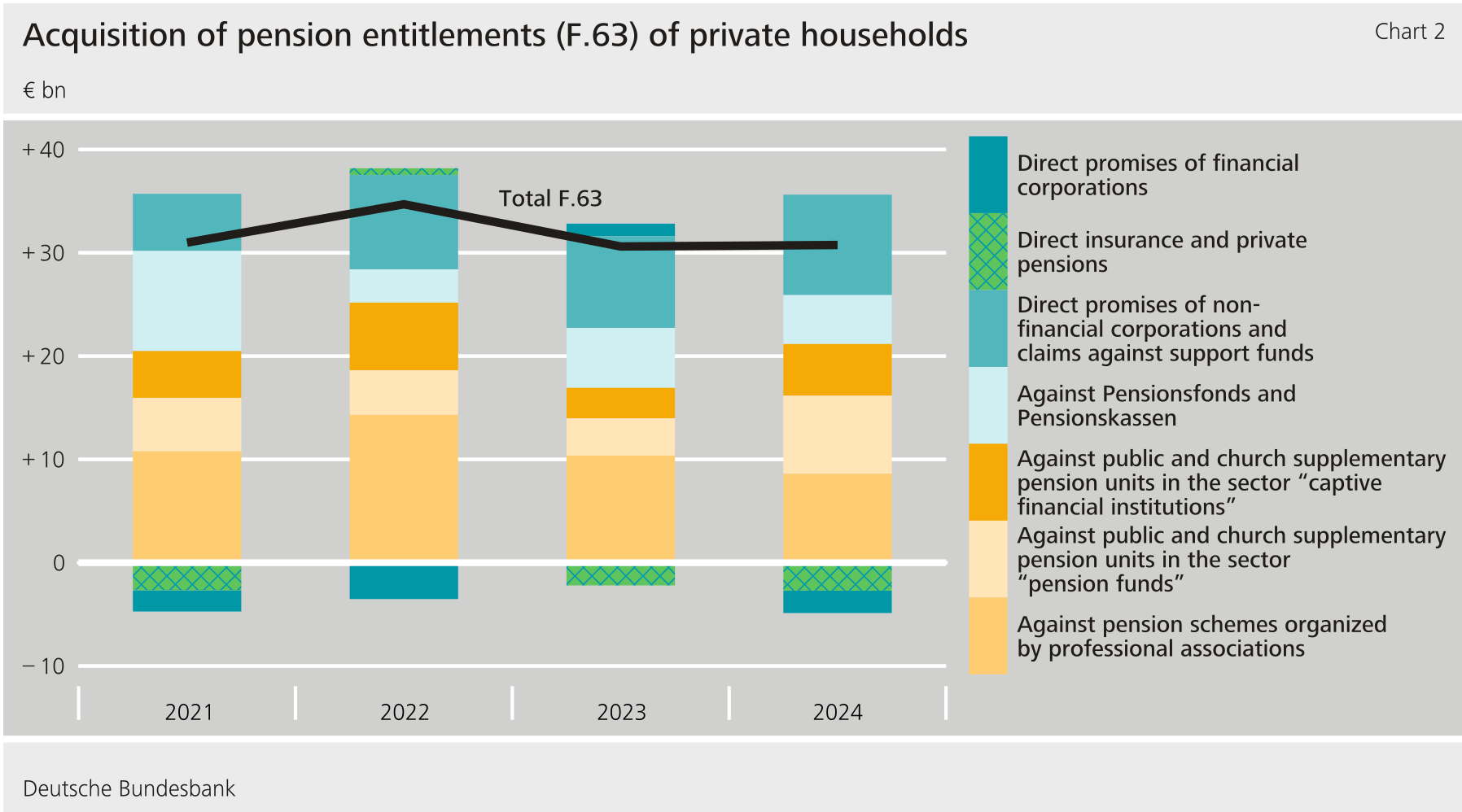
Measured annually, households’ acquisition of financial assets in pension entitlements has remained broadly constant in recent years. Private Households invested in pension products on balance. As shown in Figure 2, only direct promises from financial corporations and claims in the form of insurance products[4] were reduced on balance between 2021 and 2024. In general terms, it remains to be seen how households’ retirement provisions will develop in the future against the backdrop of demographic change.
- The European System of Accounts (ESA) 2010 is the current methodological basis for the financial accounts.
- However, an estimate of entitlements under these systems is provided every three years in ESA Table 29. According to this table, the estimated present value of households’ entitlements from statutory pension and civil servant pension schemes at the end of 2021 amounts to around €12 trillion.
- Information on the insurance statistics methodology can be found at Insurance corporations.
- Entitlements in the form of direct insurance and private pensions.