General Search
Multiple search words are automatically linked with "AND". Text enclosed in quotation marks (") returns only the pages in which this text occurs exactly. With the search filters next to the results you have the possibility to further limit your search.
-
Tägliche Rendite der börsennotierten Bundeswertpapiere
102 KB, PDF
-
Reopening of five-year Federal notes (Bundesobligationen – “Bobls”) – Auction result
172 KB, PDF
-
Fritzi Köhler-Geib appointed honorary professor at Goethe University
19.08.2025 DE
Goethe University Frankfurt has appointed Bundesbank Executive Board member Fritzi Köhler-Geib as an honorary professor. Dr Köhler-Geib has been teaching master level courses in international and development economics/economic policy within the university’s economics and business department since 2021. She will continue to provide students on her courses, which focus on the intersection of financial markets and the real economy, with her practice-oriented perspective on policy measures to support economic growth and transformation processes.
-
6-months Bills of the European Stability Mechanism (ESM) - Auction result
171 KB, PDF
-
Invitation to bid – Reopening of two Federal bonds
205 KB, PDF
-
Announcement – Federal Treasury discount paper (Bubills)
180 KB, PDF
-
Auction result– Treasury discount paper (Unverzinsliche Schatzanweisungen – “Bubills”) of the Federal Republic of Germany
173 KB, PDF
-
Main refinancing operations
The main refinancing operations, with a weekly frequency and a maturity of one week, are the most important monetary policy instrument used by the Eurosystem for money market management.
-
Invitation to bid for 6-months Bills of the European Stability Mechanism (ESM)
132 KB, PDF
-
Invitation to bid – by auction Reopening of five-year Federal notes (Bundesobligationen – “Bobls”) series 192
173 KB, PDF
-
Financial accounts
The financial accounts summarise financial flows in the economy and thereby contribute to the picture provided by the national accounts, which focus on the real economy. Among other things, they show whether, on balance, financial resources were taken up or made available and in what form (eg loans or shares).
-
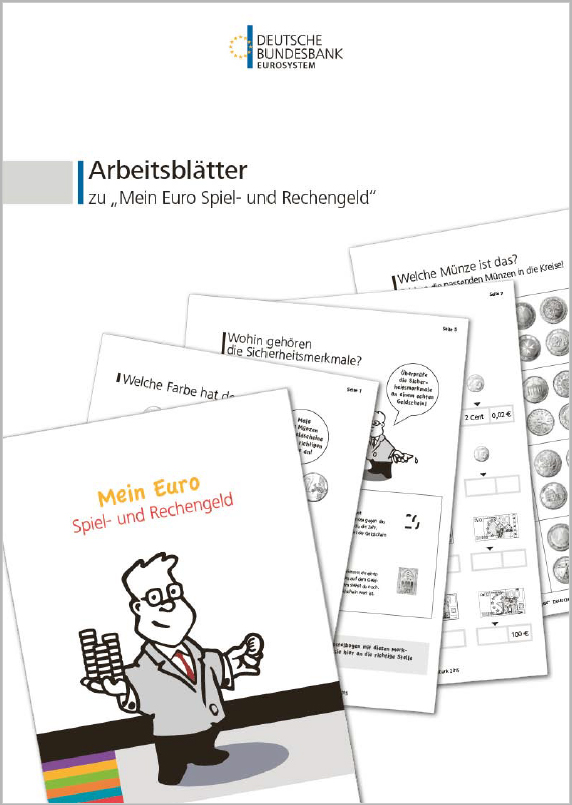
Arbeitsblätter zu „Mein Euro – Spiel- und Rechengeld“
-
Property prices and prices for construction work
The continual observation of price stability is based on analyses of price statistics. Particular attention is usually paid to the German Harmonised Index of Consumer Prices (HICP) and the national Consumer Price Index (CPI), which are both published by the Federal Statistical Office and often used throughout the EU and as inflation measures.
-
About the PHF
The German Panel on Household Finances (PHF) is a panel survey on household finance and wealth in Germany, covering the balance sheet, pension, income, work life and other demographic characteristics of private households living in Germany. The panel survey is conducted by the Research Centre of the Deutsche Bundesbank.
-
Balance sheets
The outstanding amounts of assets and liabilities resulting from the Bundesbank's financial accounts can be presented in the form of financial balance sheets for the institutional sectors.
-
-
-
-
Liquidity regulation
The purpose of prudential liquidity regulations is to ensure that institutions are liquid at all times. Quantitative provisions for liquidity were introduced into European law for the first time by the Capital Requirements Regulation (CRR, Regulation (EU) No 575/2013), in keeping with the Basel liquidity framework. The two Basel minimum standards (LCR, NSFR) and the additional monitoring metrics (AMM) were implemented by means of appropriate implementing technical standards and/or revised by Regulation (EU) 2019/876, which amended the CRR.
-
Lutz Lienenkämper Member of the Executive Board of the Deutsche Bundesbank
Since September 2024
Member of the Executive Board of the Deutsche Bundesbank -
German balance of payments in June 2025
Germany’s current account posted a surplus of €18.6 billion in June 2025, up €11.1 billion on the previous month’s level. This was mainly attributable to the swing to a surplus in invisible current transactions, which comprise services as well as primary and secondary income. Moreover, the surplus in the goods account increased somewhat.
-
Your research project at the RDSC
The Research Data and Service Centre (RDSC) provides two forms of access to selected microdata collected by the Bundesbank.
-
-
Statistics on the money markets
The statistics on the money markets is on money market transactions, namely on secured, unsecured and certain derivatives money market transactions, concluded by monetary financial institutions (MFIs), with the exception of money market funds.
-
Centralised Securities Database (CSDB)
The Centralised Securities Database is a security-by-security reference database that contains data on instruments, issuers and prices for debt securities, equity instruments and investment fund shares issued worldwide. A security-by-security database is a microdatabase that stores statistics at an individual security level.