In the first quarter of 2025, German households’ financial assets grew only slightly, closing the quarter at €9,053 billion. This represents a rise of €9 billion on the previous quarter. Households increased their claims by €90 billion, but suffered valuation losses of €82 billion.
Germany’s current account recorded a surplus of €9.6 billion in May 2025, virtually half the level seen in the preceding month. This was mainly attributable to the swing to a deficit in invisible current transactions, which comprise services as well as primary and secondary income. There was also a somewhat smaller surplus in goods trading.
The Deutsche Bundesbank calculates the basic rate of interest pursuant to Section 247(1) of the German Civil Code (Bürgerliches Gesetzbuch) and publishes its current level in the Federal Gazette (Bundesanzeiger) pursuant to Section 247(2) of the German Civil Code.
In April 2025, Germany’s current account recorded a surplus of €23.5 billion, down €9.4 billion on the previous month’s level. This was attributable to smaller surpluses in the goods account and especially in invisible current transactions, which comprise services as well as primary and secondary income.
The Bundesbank’s forecast for Germany: Economic recovery slowly getting started
US tariffs initially weigh on economic growth; fiscal policy provides impetus from 2026
The recovery of the German economy is being delayed by uncertainty surrounding international trade policy. Only gradually will economic activity be boosted by fiscal measures. The German economy will continue to tread water in the current year.
Germany’s current account recorded a surplus of €34.1 billion in March 2025, up €7.8 billion on the previous month’s level. This was attributable to larger surpluses in the goods account and especially in invisible current transactions, which comprises services as well as primary and secondary income.
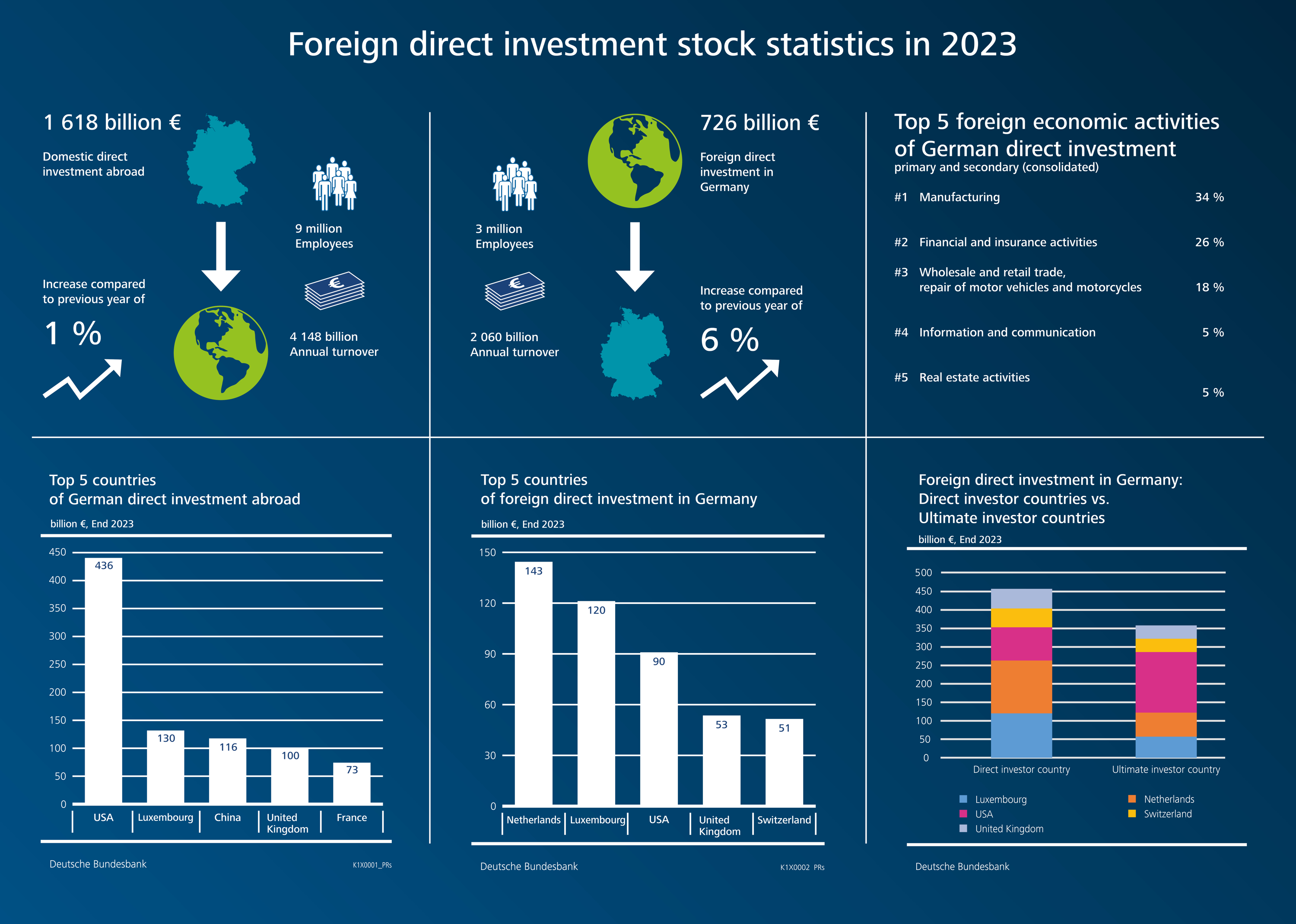
Foreign direct investment stock statistics in 2023
At year-end 2023, Germany’s primary outward foreign direct investment (FDI) stocks were up only marginally on the end of 2022 in net terms, rising from €1,694 billion to €1,701 billion. In particular, the appreciation of the euro – coupled with corresponding negative exchange rate effects – played a part in dampening the small increase in stocks. As in the previous years, equity capital accounted for the bulk of Germany’s primary outward FDI, at €1,851 billion. German investors’ foreign credit positions reduced the direct investment stocks by €150 billion on balance, as claims of €433 billion were outweighed by liabilities of €583 billion.
In the fourth quarter of 2024, German households’ nominal financial assets grew by €136 billion, totalling €9,050 billion as at the end of the year. This is now the fifth increase in succession, continuing the growth streak that has been ongoing since the end of 2023. Households increased their claims by €79 billion and generated valuation gains of €57 billion.
The German current account recorded a surplus of €20.0 billion in February 2025, up €5.0 billion on the previous month’s level. The surplus in invisible current transactions, which comprise services as well as primary and secondary income, declined slightly. However, the surplus in the goods account rose even more strongly.
General government debt in Germany increased by €57 billion in 2024 to €2.69 trillion. Central government debt grew the most, by €36 billion. State and local governments recorded an increase of €15 billion and €14 billion, respectively.
Germany’s current account recorded a surplus of €11.8 billion in January 2025, down €9.1 billion on the previous month’s level. This was attributable to a lower surplus in the goods account and especially in invisible current transactions, which comprises services as well as primary and secondary income.
By way of majority, the National Cash Forum advocates rounding up or down to the nearest 5 euro cent for cash payments in Germany. The Federal Ministry of Finance is called upon to advocate for, and press ahead with, a binding statutory rounding rule in Germany. The rounding rule should be applied across Europe as uniformly as possible.
The Bundesbank is expanding its reform proposals for central government’s debt brake, laying out a stability-oriented path towards increased government investment. It is thus presenting a concept that supports the necessary measures to strengthen infrastructure and defence whilst ensuring sustainable public finances over the long term, in line with European rules.
As in 2023, the monetary policy measures of the past few years shaped the Bundesbank’s annual accounts in the 2024 financial year. For the reporting year, it has recorded an accumulated loss of €19.2 billion.
In 2024, the Bundesbank registered approximately 72,400 counterfeit euro banknotes with a nominal value of €4.5 million in German payments. The number of counterfeits was thus up by 28% on the year.
Germany’s current account recorded a surplus of €24.0 billion in December 2024, up €2.1 billion on the previous month’s level. The surplus in the goods account decreased sharply, but the surplus in invisible current transactions, which comprise services as well as primary and secondary income, increased more strongly.
German banks tightened credit standards for loans to enterprises, loan to households for house purchase, and for consumer credit and other lending to households in the fourth quarter of 2024. Loan demand increased further in all loan categories, especially for loans to households for house purchase.
In the third quarter of 2024, German households’ financial assets grew by €197 billion, closing the quarter at a new record high of €9,004 billion. This is a continuation of the uninterrupted growth trend that has lasted since end-2023.
Germany’s current account recorded a surplus of €24.1 billion in November 2024, up €10.4 billion on the previous month’s level. This was caused by a larger surplus in the goods account and especially by the shift to a surplus in invisible current transactions, which comprise services as well as primary and secondary income.
The Deutsche Bundesbank calculates the basic rate of interest pursuant to Section 247(1) of the German Civil Code (Bürgerliches Gesetzbuch) and publishes its current level in the Federal Gazette (Bundesanzeiger) pursuant to Section 247(2) of the German Civil Code.
Paying with cash or a debit card is the cheapest payment method for consumers in Germany. Cash incurs the lowest costs per payment transaction, while debit cards are cheapest in relation to the amount of money spent. Paying with a credit card is in any case considerably more expensive. These are the conclusions drawn by a study entitled “Costs of cash and card payments from a consumer perspective”, which was carried out on behalf of the Deutsche Bundesbank.
Germany’s current account recorded a surplus of €12.5 billion in October 2024, down €8.8 billion on the previous month’s level. This was caused by the smaller surplus in the goods account and especially by the shift to a deficit in invisible current transactions, which comprise services as well as primary and secondary income.
The National Cash Forum, initiated by the Deutsche Bundesbank in February 2024, has launched a new website to serve as a neutral source of information on all aspects of cash.
Bundesbank: Financial system has weathered interest rate changes since 2022 well and is proving stable
The Financial Stability Review 2024, however, still sees elevated risk stemming from commercial real estate and owing to structural and climate change
The German financial system has weathered the period of exceptionally strongly rising interest rates well overall and remained stable over the past twelve months, too. Interest rates have gone back down in the meantime.
Germany’s current account recorded a surplus of €22.6 billion in September 2024, up €5.5 billion on the previous month’s level. This was caused by the larger surplus in the goods account and especially by the shift to a surplus in invisible current transactions, which comprise services as well as primary and secondary income.
Together for Frankfurt: New corporate initiative supports social projects in the city’s station district
17.10.2024
Press release
Deutsche Bundesbank and other institutions DE
A joint initiative by companies and institutions based in and around Frankfurt’s Bahnhofsviertel – the district surrounding its central railway station – intends to help improve the difficult situation in the area. Known as the BHV corporate initiative (BHV being an acronym for Bahnhofsviertel), it aims to make a positive contribution to the district and support selected social projects through constructive dialogue with the city.
In the second quarter of 2024, German households’ financial assets grew by €136 billion, closing the quarter at €8,815 billion. This represents a new all-time high.
For the first time in nearly three years, the German banks responding to the Bank Lending Survey (BLS) did not tighten their credit standards for loans to enterprises further in the third quarter of 2024, but eased them marginally instead. On the other hand, they once again tightened their credit standards for loans to households for house purchase and for consumer credit and other lending to households For the fourth quarter, banks are planning to tighten their credit standards for loans to enterprises again, partly owing to pessimistic market and economic expectations.
Germany’s current account recorded a surplus of €14.4 billion in August 2024, down €3.3 billion on the previous month’s level. This was chiefly attributable to a smaller goods account surplus.
Implementation in the EU of the Basel III reform package will lead to a 3.3% increase in minimum required capital (MRC) by 2030 for a sample of 36 German financial institutions. The Bundesbank calculated this result in a study based on data from large institutions in particular.
07.10.2024
Press release
Deutsche Bundesbank and BaFin DE
The banking stress test just conducted jointly by BaFin and the Bundesbank has shown that the profitability of small and medium-sized banks and savings banks in Germany improved significantly in 2023. Institutions have emerged from the interest rate reversal with stronger profitability and a higher capital base, and are also prepared for a severe crisis scenario. At a joint press conference in Frankfurt, Raimund Röseler, Chief Executive Director of Banking Supervision at BaFin, and Michael Theurer, the Bundesbank Executive Board member responsible for banking supervision, presented the results of the “LSI stress test”.
At the end of 2023, Germany’s net external assets totalled €2,964 billion, thus amounting to just over 70% of Germany’s nominal gross domestic product (GDP). Overall, both assets and liabilities vis-à-vis non-residents rose further in 2023.
The Executive Board of the Deutsche Bundesbank did not raise any objections to the nomination of Dr Fritzi Köhler-Geib as a member of the Executive Board. The outcome of the consultation has been communicated to the Bundesrat.
Germany’s current account recorded a surplus of €16.0 billion in July 2024, down €4.6 billion on the previous month’s level. This was attributable to a lower goods account surplus and a higher deficit in invisible current transactions, which comprise services as well as primary and secondary income.
The Bundesbank is once again offering the public a glimpse backstage. On 14 and 15 September, the German central bank is hosting an Open Day at its Regional Office in Hesse in Frankfurt’s city centre.
With effect from Monday, 2 September 2024, Dr Sabine Mauderer was appointed First Deputy Governor of the Bundesbank. Furthermore, Lutz Lienenkämper and Michael Theurer joined the Bundesbank’s Executive Board. The responsibilities within the Executive Board have therefore been reallocated. The following reallocation of responsibilities comes into effect
The Bundesbank has now launched the digital exhibition “From Brutus to Brandt – Coins as eyewitness and testament to our past”, which provides insight into the role that coins play as communicators of historical events.
Germany’s current account posted a surplus of € 23.2 billion in June 2024, up € 4.9 billion on the previous month’s level. The goods account surplus decreased, yet the deficit in invisible current transactions narrowed to a far greater extent.
On Friday, 26 July 2024, the Executive Board of the Deutsche Bundesbank was consulted pursuant to Section 7(3) of the Bundesbank Act on the nomination of Dr Sabine Mauderer as Vice-President and Mr Michael Theurer as Member of the Executive Board of the Deutsche Bundesbank.
In the period from January to June 2024, the Bundesbank removed significantly more counterfeit money from circulation in Germany than in the six months prior, detecting around 38,600 counterfeit euro banknotes with a nominal value of €2.4 million. This was 29% more than in the second half of 2023. Meanwhile, the total loss arising from counterfeit banknotes was only slightly up, by just under 5%. The increase was driven by easily identifiable counterfeits, especially of €10 and €20 banknotes, said Burkhard Balz, the Bundesbank’s Executive Board member whose remit includes cash management.
The number of card payments has continued to grow steadily since the end of the pandemic. In 2023, it rose by almost 16 % on the previous year to 11.8 billion transactions.
Das Nettogeldvermögen privater Haushalte ist weiter gestiegen. Die Bewertungsgewinne treiben den Vermögenszuwachs an. Die reale Rendite steigt auf 1,4 Prozent. Die Unternehmensfinanzierung steigt leicht an, Verbindlichkeiten wachsen.
The German banks responding to the Bank Lending Survey (BLS) barely tightened their credit standards for loans to enterprises any further in the second quarter of 2024. They slightly tightened their credit standards for loans to households for house purchase and for consumer credit and other lending to households. Overall, the adjustments were somewhat less than had been planned in the previous quarter.
Germany’s current account recorded a surplus of €18.5 billion in May 2024, down €6.6 billion on the previous month’s level. The goods account surplus increased slightly, but the deficit in invisible current transactions widened to a far greater extent.