Foreign direct investment (FDI) is defined as cross-border investment in enterprises with the objective of establishing a lasting and significant influence over business activities. Where investors hold 10% or more of the shares or voting rights, they are considered to have a sig-nificant degree of influence. A strategic long-term relationship is what differentiates FDI from portfolio investment.
The data on FDI are incorporated into three sets of statistics: The financial account – as a sub-account of the balance of payments – contains, on a monthly basis, the reported transactions at market value. The international investment position (i.i.p.) shows stocks at the end of each quarter. The FDI stock statistics report shows stocks at book value at the end of the year, based on corporate financial statements.
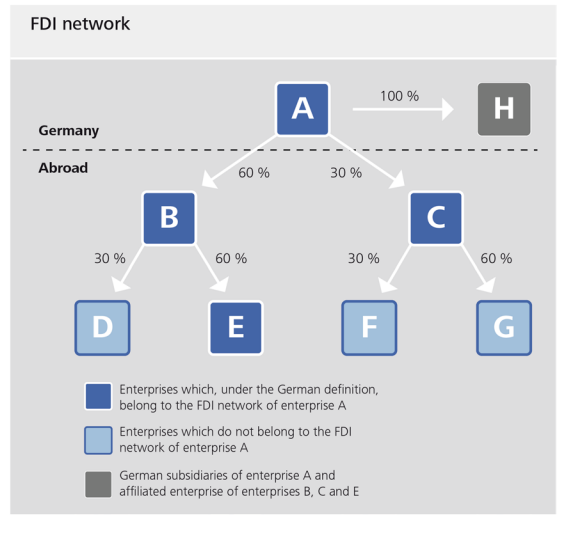
FDI may take place immediately between two enterprises (enterprise A has a 30% stake in enterprise C) or indirectly via a chain of ownership. If enterprise A has a 60% stake in enter-prise B and enterprise B a 60% stake in enterprise E, then enterprises A may be able to exer-cise indirect control and influence over enterprise E.
This distinction can only be made when looking at stocks. The aim is to record the activity of the first operating unit in the FDI relationship. This approach disregards special-purpose enti-ties and holding companies whose task is to raise capital or take over group management.
In addition, foreign direct investment can be analysed differently in terms of capital links. For more information, see the relevant pages on transactions and stocks. Data on transactions capture payments over a given period (monthly in the balance of payments and annually in the publication of FDI data). By contrast, stock data capture information at a specific point in time (end-of-quarter for the international investment position or as at the reporting date for the FDI stocks survey).
The statistics on the structure and activity of foreign affiliates (foreign affiliates statistics – FATS) provide key data on foreign-controlled enterprises.
Development of foreign direct investment (FDI) in Germany by ultimate investing economy (UIE) between 2011 and 2023
When considering foreign investment in Germany by the country of the immediate investor, the largest shares typically originate from the Netherlands and Luxembourg. These are primarily holding locations through which capital is routed. An analysis of FDI stocks by ultimate investing economy (UIE) enables the allocation of investments to the country where the group’s headquarters are located, and thus to the country where investment decisions are ultimately made. This approach can significantly shift the regional distribution of capital providers, and Germany itself appears as a source country for investments.
Foreign direct investment stock statistics in 2023
At year-end 2023, Germany’s primary outward foreign direct investment (FDI) stocks were up only marginally on the end of 2022 in net terms, rising from €1,694 billion to €1,701 billion. In particular, the appreciation of the euro – coupled with corresponding negative exchange rate effects – played a part in dampening the small increase in stocks. As in the previous years, equity capital accounted for the bulk of Germany’s primary outward FDI, at €1,851 billion. German investors’ foreign credit positions reduced the direct investment stocks by €150 billion on balance, as claims of €433 billion were outweighed by liabilities of €583 billion.