Germany’s foreign direct investment stocks at the end of 2024
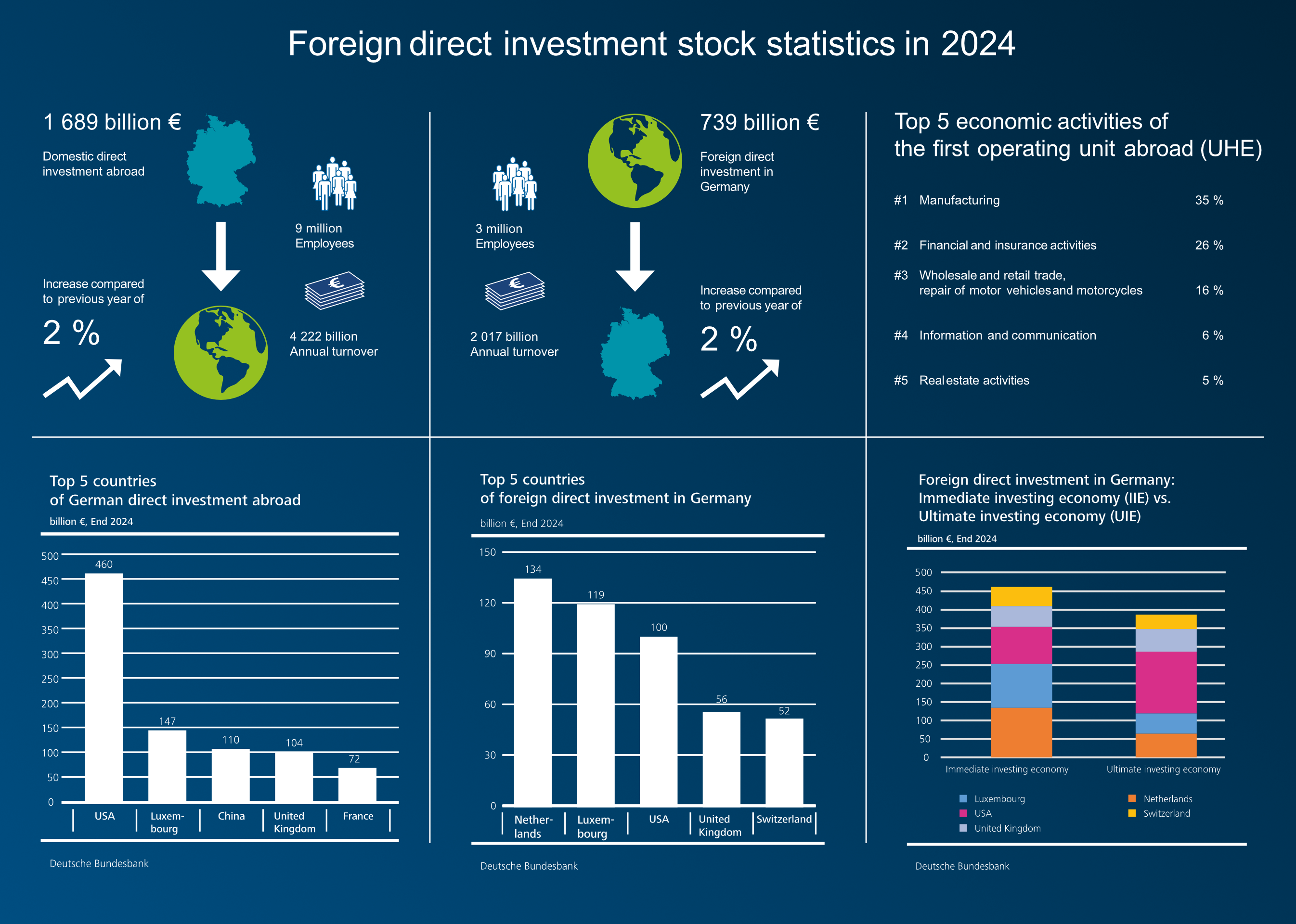
At year-end 2024, Germany’s outward foreign direct investment (FDI) stocks in immediate held enterprises (immediate host economy, IHE) were up only marginally on the end of 2023 in net terms, rising from €1,727 billion to €1,750 billion. As in the previous years, equity capital accounted for the bulk of this, at €1,884 billion. German investors’ foreign credit positions reduced the direct investment stocks by €134 billion on balance, as claims of €428 billion were outweighed by liabilities of €562 billion.
In the fourth quarter of 2025, households’ financial assets increased significantly, closing the year at €9,504 billion. This represents a rise of €148 billion on the previous quarter, with households increasing their assets by €78 billion and generating valuation gains of €70 billion.
General government debt in Germany increased by €144 billion in 2025 to €2.84 trillion. Central government debt, including its off-budget entities, grew by €107 billion.
Germany’s current account recorded a surplus of €17.1 billion in January 2026, slightly down on the previous month’s level. Although the surplus in the goods account increased, the surplus in invisible current transactions, which comprise services as well as primary and secondary income, declined slightly more sharply.
The Bundesbank’s Executive Board has made a policy decision regarding the central bank’s future location: the Bundesbank is planning to buy a property in Frankfurt that will serve as the site of its Central Office. This decision was preceded by a cost-efficiency assessment conducted by the Bundesbank with external support.
As expected, the Deutsche Bundesbank further reduced its loss for the year in 2025. In view of a significant improvement in profitability, the loss for the year fell by more than one-half compared with 2024 to €8.6 billion.
The Bundesbank identified just under 68,000 counterfeit euro banknotes in German payments in 2025. This represented a 6.1 % decrease in counterfeit banknotes year on year.
The Deutsche Bundesbank and the European Commission have launched another EU-funded programme to further support central banks and banking supervisory agencies in EU candidate countries and potential candidates from the Western Balkans
26.02.2026
Press release
Deutsche Bundesbank and other institutions
The Deutsche Bundesbank, 19 national central banks of the European System of Central Banks (ESCB) and the European Central Bank (ECB), have today jointly launched Phase III of the EU-funded “Programme for Strengthening the Central Bank Capacities in the Western Balkans” with a view to the integration to the European System of Central Banks.
German banks tightened their credit standards for loans to enterprises in the fourth quarter of 2025 to an extent not seen since 2023. This is revealed by the Bundesbank's most recent round of the Bank Lending Survey. The banks pointed to the renewed rise in credit risk as the reason for this tightening.
Two-year extension of the EU-funded programme of the European System of Central Banks (ESCB) to contribute to macroeconomic and financial stability in Africa
Joint press release with the European Commission and the Deutsche Bundesbank
20.01.2026
Press release
Deutsche Bundesbank and other institutions
The Monetary Authority of Singapore (MAS) and the Deutsche Bundesbank today signed a Memorandum of Understanding (MoU) regarding collaboration on cross-border digital asset settlement.
Two-year extension of the EU-funded programme of the European System of Central Banks (ESCB) to contribute to macroeconomic and financial stability in Africa
Joint press release with the European Commission and the Deutsche Bundesbank
20.01.2026
Press release
Deutsche Bundesbank and other institutions
The Monetary Authority of Singapore (MAS) and the Deutsche Bundesbank today signed a Memorandum of Understanding (MoU) regarding collaboration on cross-border digital asset settlement.
Germany’s current account recorded a surplus of €15.1 billion in November 2025, up €0.3 billion on the previous month’s level. Although the surplus in the goods account decreased, the swing to a surplus in invisible current transactions, which comprise services as well as primary and secondary income, was slightly stronger.
The Deutsche Bundesbank calculates the basic rate of interest pursuant to Section 247(1) of the German Civil Code (Bürgerliches Gesetzbuch) and publishes its current level in the Federal Gazette (Bundesanzeiger) pursuant to Section 247(2) of the German Civil Code.
The German economy will make headway again in 2026: while progress will be subdued initially, it will then slowly pick up, said Bundesbank President Joachim Nagel, presenting the Bundesbank’s new Forecast for Germany. According to the forecast, economic growth is being driven mainly by government spending and a resurgence in exports. The experts are expecting GDP growth in 2027 and 2028 as well.
Cash or girocard payments remain the least expensive types of payment for retailers. According to the latest Bundesbank study The cost of payment methods in the retail sector, the average cost per cash payment amounts to only €0.43. In terms of the ratio of cost to turnover, the girocard is the most cost-effective method, at an average cost of 1 % of turnover.
Germany’s current account recorded a surplus of €8.3 billion in August 2025, down €7.3 billion on the previous month’s level. This was mainly caused by the smaller surplus in the goods account and the shift to a deficit in invisible current transactions, which comprise services as well as primary and secondary income.
Banknote circulation in Germany has a small environmental footprint. This is the result of a study commissioned by the Deutsche Bundesbank which examines the environmental impact of the issuance, distribution, use and disposal of euro banknotes.