Germany’s current account posted a surplus of €19.0 billion in June 2026, up €10.1 billion on the previous month’s level. This was mainly attributable to the swing to a surplus in invisible current transactions, which comprise services as well as primary and secondary income. There was also a higher surplus in the goods account.
In April 2026, Germany’s current account recorded a surplus of €13.8 billion, down €10.7 billion on the previous month’s level. This was attributable to lower surpluses in the goods account and in invisible current transactions, which comprise services as well as primary and secondary income.
Germany’s current account recorded a surplus of €23.6 billion in March 2026. This was €3.1 billion up on the previous month’s level. The goods account surplus decreased, but the surplus in invisible current transactions, which comprise services as well as primary and secondary income, increased more strongly.
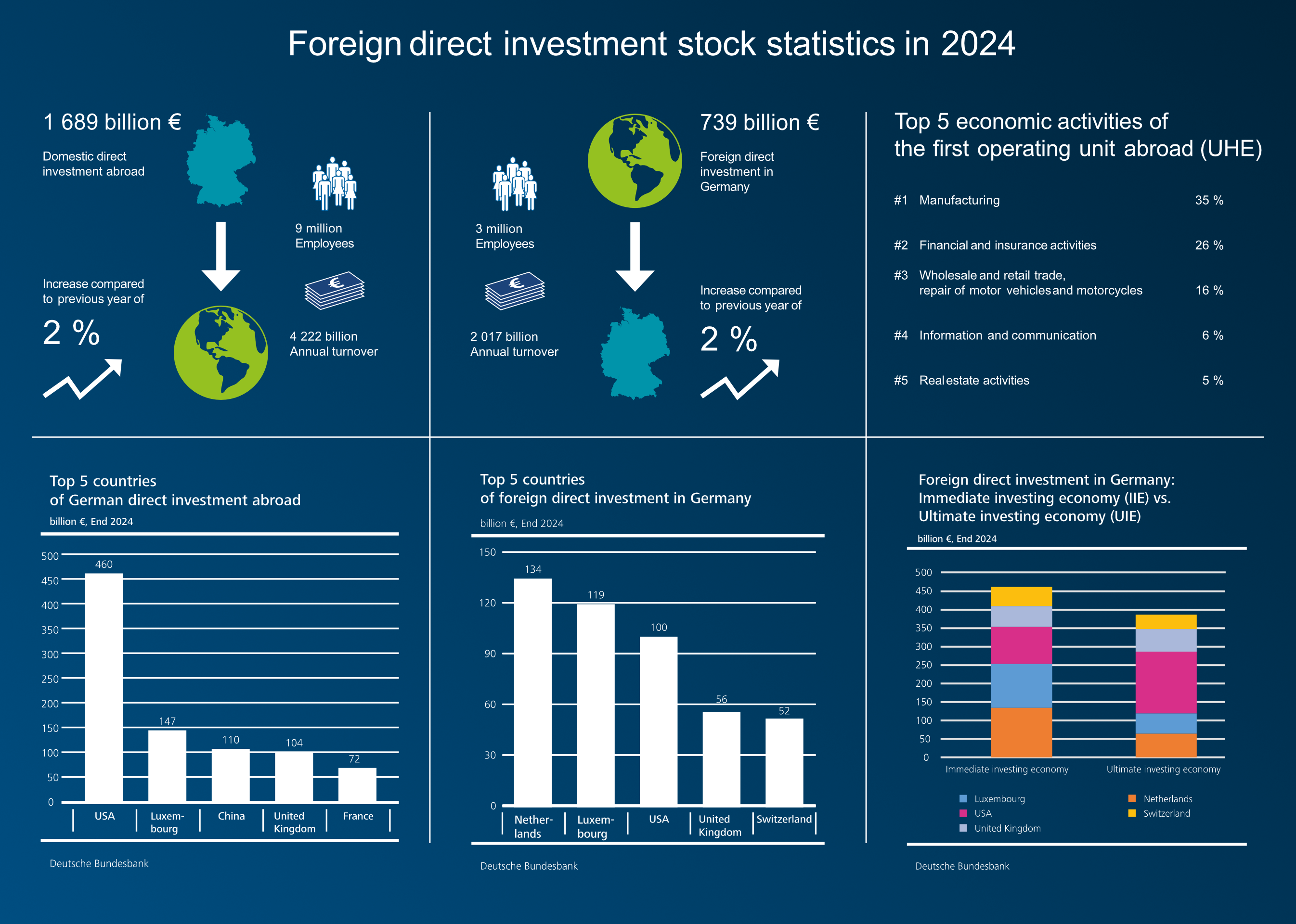
Germany’s foreign direct investment stocks at the end of 2024
At year-end 2024, Germany’s outward foreign direct investment (FDI) stocks in immediate held enterprises (immediate host economy, IHE) were up only marginally on the end of 2023 in net terms, rising from €1,727 billion to €1,750 billion. As in the previous years, equity capital accounted for the bulk of this, at €1,884 billion. German investors’ foreign credit positions reduced the direct investment stocks by €134 billion on balance, as claims of €428 billion were outweighed by liabilities of €562 billion.
Germany’s current account recorded a surplus of €17.1 billion in January 2026, slightly down on the previous month’s level. Although the surplus in the goods account increased, the surplus in invisible current transactions, which comprise services as well as primary and secondary income, declined slightly more sharply.
Germany’s current account recorded a surplus of €15.1 billion in November 2025, up €0.3 billion on the previous month’s level. Although the surplus in the goods account decreased, the swing to a surplus in invisible current transactions, which comprise services as well as primary and secondary income, was slightly stronger.
Germany’s current account recorded a surplus of €8.3 billion in August 2025, down €7.3 billion on the previous month’s level. This was mainly caused by the smaller surplus in the goods account and the shift to a deficit in invisible current transactions, which comprise services as well as primary and secondary income.